

INSTRUCTION: Answers four questions in all, any two from each section
SECTION A
HUMAN GEOGRAPHY
Number 1
(1a)
(PICK ANY FOUR)
(i) Availability of water: Settlements grow rapidly in places where there is a reliable supply of water from rivers, lakes, wells or boreholes. Water is needed for drinking, domestic activities, agriculture and industrial production.
(ii) Relief of the land: Flat or gently sloping land encourages settlement growth because it makes the construction of houses, roads and other facilities easier. Steep and rugged areas discourage settlement because construction is difficult and expensive.
(iii) Fertile soil: Areas with fertile soil attract farmers because they support crop production. Increased agricultural activities provide food, employment and raw materials, thereby encouraging population growth.
(iv) Transportation and accessibility: Settlements located along major roads, railways, waterways or air routes usually grow faster. Good transport promotes the movement of people, goods and services and encourages commercial activities.
(v) Availability of mineral resources: The discovery and exploitation of minerals such as petroleum, coal, limestone and iron ore attract workers and industries. This increases population and leads to the development of settlements.
(vi) Industrial and commercial activities: The establishment of industries, markets, banks and offices creates employment opportunities. People migrate to such settlements in search of jobs and better living conditions.
(vii) Security: People prefer to live in places where their lives and property are protected. Settlements in peaceful areas grow faster, while insecurity, wars and communal conflicts discourage growth.
(viii) Administrative functions: A settlement chosen as a local government, state or national capital attracts government offices, workers and social amenities. These activities encourage its expansion.
(1b)
(PICK ANY FOUR)
(i) Population: A town has a large population, while a village has a relatively small population.
(ii) Physical size: A town covers a larger area, while a village occupies a smaller area.
(iii) Occupation: Most people in towns engage in secondary and tertiary activities such as manufacturing, trading and banking, while most villagers engage in primary activities such as farming, fishing and hunting.
(iv) Social amenities: Towns have more schools, hospitals, electricity, banks and pipe-borne water, while villages have fewer and less-developed social amenities.
(v) Buildings: Towns contain many modern, closely spaced and storey buildings, while villages mainly contain simple, scattered and low-rise houses.
(vi) Transportation: Towns have better road networks and more means of transport, while villages often have fewer roads and limited transportation facilities.
(vii) Social relationships: Relationships in towns are usually formal and less personal, while relationships in villages are closer and more personal.
(viii) Level of commercial activity: Towns have large markets, industries and many business establishments, while villages have smaller markets and fewer commercial activities.
Number 2
(2a)
(PICK ANY FOUR)
(i) Tourism creates employment opportunities in hotels, transport services, restaurants and tourist centres.
(ii) It generates foreign exchange through the spending of international tourists.
(iii) It increases government revenue through taxes, entrance fees and licences.
(iv) It promotes the development of roads, airports, electricity and communication facilities.
(v) It encourages the growth of local industries such as handicrafts, food processing and entertainment.
(vi) It improves the income and standard of living of people living around tourist centres.
(2b)
(PICK ANY FOUR)
(i) Inadequate transport facilities: Poor roads, limited air services and unreliable public transportation make many tourist attractions difficult to reach.
(ii) Insecurity: Kidnapping, armed robbery, terrorism and communal conflicts discourage both local and foreign tourists from visiting affected areas.
(iii) Poor accommodation facilities: The shortage of clean and affordable hotels, restaurants and recreational centres reduces the comfort of tourists.
(iv) Inadequate publicity: Many tourist attractions are not properly advertised through television, radio, websites and social media. Therefore, potential tourists may not know about them.
(v) Poor maintenance: Some tourist sites are neglected and allowed to become dirty or damaged, making them unattractive to visitors.
(vi) Inadequate funding: Governments and private investors may not provide enough money to develop, protect and manage tourist centres.
(vii) Unfriendly government policies: Difficult visa procedures, high taxes and unnecessary restrictions can discourage foreign tourists.
(viii) Shortage of trained personnel: The lack of qualified tour guides, hotel workers and tourism officers leads to poor services.
(2c)
(PICK ANY TWO)
(i) The government should improve security around tourist centres and major transport routes by deploying trained security personnel and surveillance equipment.
(ii) Roads, airports, hotels, electricity and communication facilities should be developed and properly maintained.
(iii) Tourist attractions should be widely advertised through the mass media and international tourism exhibitions.
(iv) The government and private investors should provide adequate funds for the development and maintenance of tourist centres.
(v) Tourism workers should be properly trained to provide efficient and friendly services.
Number 3
(3a)
(i) Two products of the Southern Japan industrial region:
- Iron and steel products.
- Ships and automobiles.
Other products include electrical appliances, textiles, chemicals, machinery and petroleum products.
(ii) Factors that favour its growth:
(PICK ANY THREE)
- Availability of good ports: Ports such as Osaka, Kobe and Kitakyushu make it easy to import raw materials and export finished goods.
- Large market: The region has a dense population and large cities that provide a ready market for manufactured products.
- Adequate transport facilities: The area has efficient roads, railways, seaports and air transport for moving raw materials, workers and finished goods.
- Availability of skilled labour: The region has a large number of trained and experienced industrial workers.
- Advanced technology: Modern machines, scientific research and improved production methods encourage industrial development.
- Availability of capital: Banks, private investors and government support provide funds for establishing and expanding industries.
- Coastal location: Many industries are located near the sea, where imported bulky raw materials can be transported cheaply.
(iii) Contributions to the economy of Japan:
(PICK ANY THREE)
- It creates employment opportunities for millions of people.
- It earns foreign exchange through the export of ships, vehicles, machines and electronic products.
- It contributes greatly to Japan’s national income and economic growth.
- It encourages the development of transport, electricity, communication and port facilities.
- It supplies manufactured goods for domestic use.
- It promotes the growth of related industries and commercial activities.
- It attracts foreign investment and improves Japan’s international trade.
(3b)
(PICK ANY FOUR)
- Concentration of industries causes overcrowding and traffic congestion in urban centres.
- It leads to air, water, land and noise pollution.
- It creates pressure on housing, electricity, water supply, schools and hospitals.
- It encourages the development of slums and poor living conditions.
- It causes regional imbalance because rural areas receive less industrial development.
- It increases the cost of land, housing and other basic needs.
- It may increase crime, unemployment and other social problems.
- Industrial waste may cause health problems among urban residents.
SECTION B
GEOGRAPHY OF NIGERIA
Number 4
(4a)
Population census is the official counting of all the people living in a country at a particular time, together with the collection of information about their age, sex, occupation, education and place of residence.
(4b)
(PICK ANY FOUR)
(i) Planning for social amenities: Census figures help the government determine the number and location of schools, hospitals, roads, water projects and electricity facilities needed by the people.
(ii) Allocation of resources: Population data are used to distribute national revenue and other government resources among states and local government areas.
(iii) Political representation: Census results help to determine the number of electoral constituencies and representatives allocated to different parts of the country.
(iv) Employment planning: Information about the working population enables the government to formulate employment policies and create suitable job opportunities.
(v) Economic planning: Census data help the government prepare development plans, budgets and policies based on the size and needs of the population.
(vi) Determination of population characteristics: It provides information about the age, sex, occupation, education, marital status and geographical distribution of the population.
(vii) Provision of housing: The government uses census data to estimate housing needs and plan housing programmes in densely populated areas.
(viii) Security planning: Population figures help the government decide where police stations, military formations and emergency services should be located.
(4c)
Advantages of high population density:
(PICK ANY THREE)
(i) It provides a large labour force for industries, agriculture and other economic activities.
(ii) It creates a large market for goods and services.
(iii) It encourages the development of roads, schools, hospitals, electricity and communication facilities.
(iv) It promotes specialization and division of labour.
(v) It increases government revenue through taxes and rates.
Disadvantages of high population density:
(PICK ANY THREE)
(i) It causes overcrowding and shortage of accommodation.
(ii) It increases pressure on schools, hospitals, water supply and other social amenities.
(iii) It may lead to unemployment and underemployment.
(iv) It encourages traffic congestion and the growth of slums.
(v) It may increase crime, pollution and the spread of diseases.
(vi) It places heavy pressure on available land and natural resources.
Number 5
(5a)
(PICK ANY FOUR)
(i) Provision of food: Agriculture supplies food crops such as yam, cassava, maize, rice and beans, as well as meat, fish, milk and eggs. This feeds the population and reduces dependence on imported food.
(ii) Provision of employment: Agriculture provides jobs for farmers, fishermen, livestock rearers, produce buyers, transporters and workers in agro-based industries. It therefore helps to reduce unemployment in Nigeria.
(iii) Provision of raw materials: Agricultural products supply raw materials to industries. For example, cotton is used by textile industries, cocoa by beverage industries, oil palm by soap industries, rubber by tyre industries and hides and skins by leather industries.
(iv) Generation of foreign exchange: Nigeria earns foreign exchange from the export of agricultural products such as cocoa, sesame seeds, cashew nuts, rubber, ginger and hides and skins. The revenue earned contributes to national development.
(v) Contribution to national income: Agriculture contributes to Nigeria’s Gross Domestic Product through crop production, livestock farming, forestry and fishing. It also generates revenue for the government through taxes and export duties.
(vi) Development of rural areas: Agricultural activities encourage the provision of rural roads, markets, storage facilities, electricity and water supply. These facilities improve the standard of living of rural residents.
(vii) Promotion of industrial development: Agriculture encourages the establishment of agro-based industries such as flour mills, textile factories, breweries, sugar factories and vegetable oil mills.
(viii) Provision of market for industrial goods: Farmers purchase fertilizers, tractors, hoes, cutlasses, pesticides, bags and other manufactured goods. This creates a market for industrial products.
(5b)
(PICK ANY FOUR)
(i) Inadequate capital prevents farmers from buying modern machinery, improved seedlings, fertilizers and other necessary inputs.
(ii) The use of crude tools and traditional farming methods leads to low productivity.
(iii) Poor transportation facilities make it difficult and expensive to move farm produce from rural areas to markets.
(iv) Pests and diseases destroy crops and livestock, thereby reducing agricultural output.
(v) Inadequate storage facilities result in the spoilage and wastage of farm produce.
(vi) Unfavourable land-tenure systems cause the fragmentation of farmland and make it difficult for farmers to obtain large areas of land.
(vii) Rural–urban migration reduces the number of young and energetic people available for agricultural work.
(viii) Unreliable rainfall, floods and droughts negatively affect crop and livestock production.
(5c)
(PICK ANY TWO)
(i) The government and financial institutions should provide farmers with affordable loans, grants and subsidies to enable them to purchase modern equipment and farm inputs.
(ii) Modern storage facilities, processing centres and good rural roads should be provided to reduce post-harvest losses and improve the movement of produce.
(iii) Agricultural extension officers should train farmers in modern farming techniques and the control of pests and diseases.
(iv) Irrigation facilities should be developed to reduce excessive dependence on rainfall.
Number 6
(6a)
(DIAGRAM)
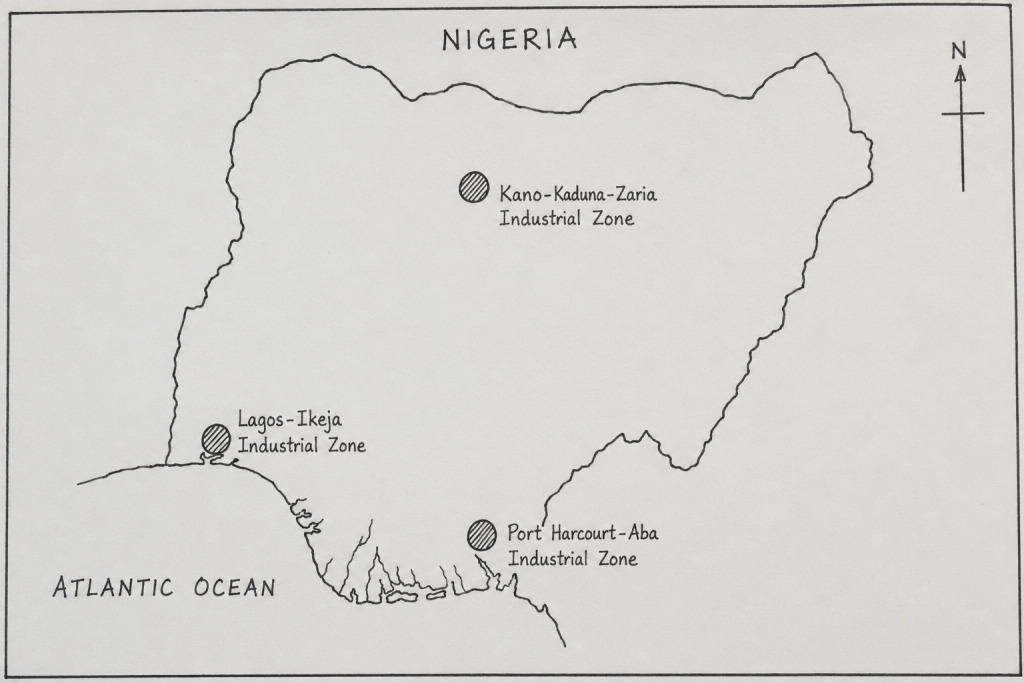
Three industrial zones to locate and label on the sketch map of Nigeria are:
(i) Lagos–Ikeja industrial zone.
(ii) Kano–Kaduna–Zaria industrial zone.
(iii) Port Harcourt–Aba industrial zone.
(6b)
(PICK ANY THREE)
(i) Provision of employment: Manufacturing industries employ factory workers, engineers, technicians, drivers, accountants and sales representatives. For example, textile and food-processing industries provide employment for many Nigerians.
(ii) Production of essential goods: Manufacturing industries produce goods needed by the population, such as cement, textiles, medicines, beverages, vehicles and household materials. This reduces dependence on imported products.
(iii) Provision of market for raw materials: Industries purchase agricultural and mineral raw materials from local producers. For example, textile industries use cotton, flour mills use wheat and maize, while cement factories use limestone.
(iv) Generation of government revenue: Manufacturing companies pay taxes, duties, registration fees and other charges to the government. The revenue is used to provide roads, schools, hospitals and other public facilities.
(v) Earning and conservation of foreign exchange: Exported manufactured products earn foreign exchange, while local production reduces the amount spent on importing similar goods.
(vi) Promotion of infrastructural development: The establishment of industries encourages the provision of roads, electricity, water supply, communication facilities and housing.
(vii) Development of related businesses: Manufacturing encourages the growth of transport, banking, insurance, advertising, packaging and wholesale businesses.
(viii) Improvement in standard of living: Industries provide income and make essential products available to the people, thereby improving their living conditions.
(6c)
(PICK ANY FOUR)
(i) Inadequate and unreliable electricity supply.
(ii) Shortage and high cost of raw materials.
(iii) Inadequate capital and high interest rates.
(iv) Poor transportation facilities.
(v) Shortage of skilled labour.
(vi) Competition from cheaper imported goods.
(vii) Inconsistent government policies and excessive taxation.
(viii) Limited market caused by low purchasing power.
(ix) Insecurity and political instability.
(x) Use of outdated machinery and technology.
COMPLETED!!!