
NECO Civic Education OBJ
OSUN STATE
CIVIC OBJ (OSUN STATE)
1. B – citizens
2. E – apathy
3. E – 1993
4. D – trafficking
5. E – democracy
6. A – supremacy of the law
7. B – destruction
8. B – civil society
9. E – Interpretation of laws
10. C – training and testing drivers
11. B – election
12. E – political party
13. B – orderliness
14. A – Nigeria Labour Congress
15. B – electorates
16. A – Abraham Lincoln
17. C – Registration
18. E – stigmatization
19. D – bourgeoisie
20. B – permissive attitudes
21. C – chaos
22. A – Empathy and sincerity
23. C – anarchy
24. E – retrogression
25. C – local
26. D – National Orientation Agency
27. C – are partisan
28. A – perform their duties towards their wards
29. A – solidarity and love
30. A – age
31. C – vote during elections
32. A – Greed
33. B – political
34. E – there is press censorship
35. C – social interest
36. A – orientation programmes
37. B – dialogue
38. B – poverty
39. A – justice
40. E – free from external control and interference
41. D – death
42. B – political
43. A – empower
44. E – manifesto
45. A – Mood swing
46. B – building a successful nation
47. C – unemployment
48. D – executive
49. E – Albert Dicey
50. D – President of the Senate
51. E – Constitution
52. D – public enlightenment
53. C – people are passive during elections
54. D – Education
55. E – loss of individual freedom
56. B – ensure safety
57. B – Commuters who knowingly transport the victims
58. D – 4-
59. C – one
60. E – develop patriotic mindset
OYO STATE
CIVIC OBJ (OYO STATE)
1. E — supremacy of the law
2. E — coup
3. A — qualified citizens
4. C — orderliness
5. B — Olusegun Obasanjo
6. E — Interpretation of laws
7. D — trafficking
8. A — selfishness
9. A — bourgeoisie
10. B — Covetousness
11. A — declaration of state of emergency
12. A — training and testing drivers
13. B — destruction
14. D — election
15. E — Nigerian Red Cross
16. B — engaging in thuggery
17. D — unstable government
18. A — Registration
19. B — creating public awareness
20. C — chaos
21. E — death
22. C — public enlightenment
23. A — social interest
24. A — National Drug Law Enforcement Agency
25. D — solidarity and love
26. D — Undermining human rights
27. D — partisan to enable it serve the government
28. C — National Orientation Agency
29. C — Unstable government
30. C — Empathy and sincerity
31. C — tolerance
32. E — duties and obligations
33. A — Shehu Shagari
34. C — constructive criticism
35. A — perform their duties towards their wards
36. C — promoting public health
37. C — legal
38. A — orientation programmes
39. B — Judiciary
40. E — rigid
41. A — unemployment
42. D — Paris
43. A — contest general elections
44. E — free from external control and interference
45. D — vote during elections
46. C — villages
47. A — President of the Senate
48. A — poverty
49. C — House of Representatives
50. E — dialogue
51. B — solicit to win elections
52. E — anarchy
53. C — it endangers the security of the state
54. E — 7
55. A — Harmony
56. B — one
57. D — refugee camps
58. D — specialisation
59. D — ensure safety
60. D — develop patriotic mindset
IMO STATE
CIVIC OBJ (IMO STATE)
1. B – Covetousness
2. C – Voting during elections
3. E – Code of Conduct Bureau
4. A – coup
5. B – representative
6. E – bourgeoisie
7. E – HIV/AIDS
8. B – training and testing drivers
9. A – Independent National Electoral Commission
10. A – political party
11. E – Civic Education
12. A – decorum
13. E – Nigeria Labour Congress
14. D – qualified citizens
15. C – democracy
16. C – destruction
17. B – civil society
18. D – declaration of state of emergency
19. D – cultural
20. D – Envy
21. A – justice
22. B – Education
23. B – suspicion
24. C – violation
25. D – court
26. B – low participation
27. D – legal-rational
28. C – orientation programmes
29. E – age
30. C – House of Representatives
31. C – solicit to win elections
32. D – free from external control and interference
33. E – orderliness
34. D – dialogue
35. E – legal
36. D – contest general elections
37. C – uniformity
38. E – vote during elections
39. E – British
40. D – Operation Feed the Nation
41. D – contribute to the development of the society
42. C – poverty
43. C – chaos
44. E – Mood swing
45. C – encouraging social segregation among children
46. B – lift up
47. C – Movement
48. D – retrogression
49. E – acrimony
50. B – Greed
51. C – tranquillity
52. C – capitalism
53. A – public enlightenment
54. E – Education
55. A – Harmony
56. D – corruption
57. C – Commuters who knowingly transport the victims
58. B – patriotism
59. B – 4-
60. C – becomes a security threat
ZAMFARA STATE
CIVIC OBJ (ZAMFARA STATE)
1. E – patriotism
2. A – trafficking
3. D – coup
4. A – cultural
5. A – supremacy of the law
6. A – mace
7. C – creating public awareness
8. B – qualified citizens
9. C – electorates
10. B – covetousness
11. C – abuse
12. C – unstable government
13. B – Olusegun Obasanjo
14. B – democracy
15. A – Nigerian Red Cross
16. C – democracy
17. A – trafficking
18. C – apathy
19. B – decorum
20. A – permissive attitudes
21. E – public enlightenment
22. D – acrimony
23. A – depression
24. A – Shehu Shagari
25. A – mood swing
26. E – are partisan
27. E – it endangers the security of the state
28. C – solidarity and love
29. A – approval of annual budget
30. D – villages
31. B – all citizens are equal before the law
32. E – poor representation of citizens’ interests
33. D – peace
34. C – blood transfusion
35. D – House of Representatives
36. E – violation
37. D – chaos
38. C – orientation programmes
39. C – executive
40. A – retrogression
41. A – delinquency
42. D – Ibrahim Babangida
43. C – Paris
44. A – death
45. A – National Orientation Agency
46. E – reliable
47. E – constructive criticism
48. D – free from external control and interference
49. C – empower
50. D – orderliness
51. D – political
52. C – sanctioning culprits
53. B – undermining human rights
54. E – patriotism
55. C – harmony
56. D – develop patriotic mindset
57. E – commuters who knowingly transport the victims
58. E – generous
59. E – 7
60. E – refugee camps
ABUJA
CIVIC OBJ (ABUJA)
1. E – France
2. election (option letter not visible in the crop — leaders in a representative democracy acquire power through election)
3. C – Political party
4. Coup (option letter not visible in the crop — likely C or D)
5. B – Electorates
6. D – Unstable government
7. B – 1996
8. B – Trafficking
9. E – Contentment
10. A – Commander of the Federal Republic
11. D – Code of Conduct Bureau
12. E – Inter-personal
13. C – Socialisation
14. A – Decorum
15. A – Covetousness
16. D – Caffeine
17. B – Contentment
18. B – Manipulating election results
19. B – Civic Education
20. A – Endanger lives
21. D – Encouraging social segregation among children
22. E – 1999
23. E – Unstable government
24. E – Operation Feed the Nation
25. E – Contest general elections
26. C – Lift up
27. E – Perform their duties towards their wards
28. A – Solidarity and love
29. C – Duties and obligations
30. E – Poverty
31. E – Intercultural marriage
32. D – Orientation programmes
33. E – There is press censorship
34. E – Delinquency
35. B – Taken on friends’ advice
36. D – Vote during elections
37. E – Age
38. E – Executive
39. A – Paris
40. E – Sanctioning culprits
41. E – Tolerance
42. C – Envy
43. C – Capitalism
44. E – Mood swing
45. E – Tranquillity
46. C – Attacked
47. B – Increases personal wealth
48. B – Contented
49. E – Depression
50. D – Chaos
51. C – Justice
52. D – Ibrahim Babangida
53. E – All citizens are equal before the law
54. D – Doctors’ prescription
55. B – Reduce multiplication of the virus
56. A – One
57. B – Ensure safety
58. A – Education
59. C – Commuters who knowingly transport the victims
60. A – 4-year
BORNO
CIVIC OBJ( BORNO)
1. A – France
2. A – Manipulating election results
3. E – Civil society
4. E – Democracy
5. E – Abuse
6. A – Voting during elections
7. B – Opposition
8. A – Olusegun Obasanjo
9. B – Honesty
10. E – Commander of the Federal Republic
11. D – Qualified citizens
12. D – HIV/AIDS
13. E – Citizen
14. A – Inter-personal
15. C – Electorates
16. B – Discrimination
17. E – Discrimination
18. B – Trafficking
19. A – Registration
20. B – Dialogue
21. A – Permissive attitudes
22. B – Death
23. D – Building a successful nation
24. A – It endangers the security of the state
25. A – Sanctioning culprits
26. C – Shehu Shagari
27. B – Perform their duties towards their wards
28. A – People are passive during elections
29. B – National Agency for Food and Drug Administration and Control
30. D – Judiciary
31. B – Acrimony
32. D – 1999
33. E – Empower
34. D – Two
35. A – Orientation programmes
36. C – Endanger lives
37. B – Thugs and hoodlums
38. A – National Orientation Agency
39. C – Poverty
40. E – National Drug Law Enforcement Agency
41. C – Economic
42. A – Improved welfare
43. E – Loss of smell
44. D – Poor representation of citizens’ interests
45. A – Reliable
46. D – Academic difficulties
47. B – Duties and obligations
48. A – Constructive criticism
49. E – Unstable government
50. A – Suspicion
51. C – Operation Feed the Nation
52. C – Empathy and sincerity
53. A – Contribute to the development of the society
54. E – Education
55. D – One
56. D – Gainful employment
57. B – Refugee camps
58. D – Apprenticeship
59. A – Commuters who knowingly transport the victims
60. B – Reduce multiplication of the virus
NASARAWA
CIVIC OBJ (NASARAWA)
1. B
2. C
3. C
4. C
5. E
6. A
7. A
8. C
9. E
10. E
11. E
12. A
13. C
14. C
15. E
16. E
17. D
18. C
19. B
20. D
21. B
22. B
23. E
24. A
25. A
26. A
27. A
28. C
29. A
30. E
31. E
32. A
33. A
34. D
35. B
36. B
37. E
38. D
39. E
40. C
41. C
42. D
43. B
44. D
45. C
46. C
47. C
48. C
49. C
50. C
51. D
52. C
53. B
54. E
55. E
56. E
57. B
58. C
59. A
60. B
ANAMBRA
CIVIC OBJ (ANAMBRA)
1. E – 1993
2. D – Bourgeoisie
3. D – Creating public awareness
4. E – Contentment
5. B – Manipulating election results
6. A – Registration
7. C – Code of Conduct Bureau
8. C – Destruction
9. C – Representative
10. A – Interpretation of laws
11. D – Trafficking
12. B – Engaging in thuggery
13. B – Democracy
14. D – Olusegun Obasanjo
15. D – Supremacy of the Rule of Law
16. C – Patriotism
17. A – Prostitution
18. C – Orderliness
19. A – Accrediting Driving Schools
20. A – Free from External Control and Interference
21. A – Sacrifice
22. A – Taken on Friends’ Advice
23. D – Political
24. B – Partisan to enable it serve the government
25. D – National Orientation Agency (NOA)
26. B – Empower
27. C – Negligence
28. E – National Drug Law Enforcement Agency (NDLEA)
29. D – Sanctioning Culprits
30. E – Poor Representation of Citizens’ Interests
31. A – Endanger Lives
32. E – Intercultural Marriage
33. D – Directorate of Employment
34. E – Greed
35. E – Justice
36. E – Judiciary
37. A – contribute to the development of the society
38. B – manifesto
39. E – building a successful nation
40. E – justice
41. B – Shehu Shagari
42. B – capitalism
43. B – tolerance
44. A – rigid
45. D – National Agency for Food and Drug Administration and Control (NAFDAC)
46. D – Education
47. C – are partisan
48. B – Increases personal wealth
49. D – legal
50. E – exercise voting rights
51. B – Approval of annual budget
52. C – people are passive during elections
53. C – Paris
54. A – respects no one
55. C – Harmony
56. B – Commuters who knowingly transport the victims
57. D – intercourse
58. A – generous
59. D – National Youth Service Corps (NYSC)
60. D – timely capacity building
ENUGU
CIVIC OBJ (ENUGU STATE)
1-10: ABCEDEBBAA
11-20: ECDEAECCCE
21-30: ECBDCEEDDD
31-40: BCBEEBDBEE
41-50: CDDDCAECCB
51-60: ABADDCCCEA
EDO
CIVIC OBJ (EDO STATE)
1. B – Abraham Lincoln
2. B – apathy
3. E – contentment
4. A – cultural
5. B – stigmatization
6. C – unstable government
7. A – pressure group
8. B – declaration of state of emergency
9. E – United States of America
10. A – orderliness
11. C – qualified citizens
12. B – Abraham Lincoln
13. D – electorates
14. A – citizens
15. D – democracy
16. E – patriotism
17. D – creating public awareness
18. C – engaging in thuggery
19. A – trafficking
20. E – Standards Organisation of Nigeria
21. C – people
22. A – Vigilante Group of Nigeria
23. B – age
24. B – are partisan
25. C – executive
26. C – orientation programmes
27. B – capitalism
28. C – there is press censorship
29. A – Unstable government
30. B – political
31. B – Approval of annual budget
32. D – primary
33. D – tolerance
34. C – perform their duties towards their wards
35. B – National Drug Law Enforcement Agency
36. E – Greed
37. C – Suspicion
38. A – economic
39. E – peace
40. B – death
41. A – political
42. D – exercise voting rights
43. A – permissive attitudes
44. B – solicit to win elections
45. A – justice
46. B – promoting public health
47. E – tramadol
48. B – engagement in the democratic process
49. E – executive
50. E – Youth Service Corps
51. E – Empathy and sincerity
52. C – encouraging social segregation among children
53. E – rigid
54. E – 5
55. A – generous
56. B – specialisation
57. B – loss of individual freedom
58. B – timely capacity building
59. A – Education
60. A – respects no one
KANO
CIVIC OBJ (KANO STATE)
1–10: DCAEAADBAA
11–20: BCDDEEAECB
21–30: BBBEBBBEBA
31–40: DADCDBDDDE
41–50: CBECDDCEBA
51–60: CBAECEEDAE
KADUNA
CIVIC OBJ (KADUNA STATE)
1–10: EBACDEAABD
11–20: CEDDBCAABC
21–30: CAECECCBBB
31–40: ABCDEBDCDB
41–50: CEABDCDDEB
51–60: BEADDBDEDB
LAGOS
CIVIC OBJ (LAGOS STATE)
Q1–10
1. E – Olusegun Obasanjo. The HIV/AIDS National Action Committee was set up under him.
2. E – France. UDHR was adopted in Paris, France in 1948.
3. D – Grand Commander of the Federal Republic GCFR
4. C – Code of Conduct Bureau. Handles asset declaration for public officers.
5. A – trafficking. Trading in illicit substances.
6. E – declaration of state of emergency. Rights can be suspended.
7. A – Nigeria Labour Congress. Example of a civil society organisation.
8. B – Covetousness. Attribute of dishonesty.
9. B – apathy. Lack of interest in democratic processes.
10. A – ethnic. Relationship between tribes.
Q11–20
11. C – manipulating election results. This is NOT popular participation.
12. A – Interpretation of laws. That’s judiciary, not executive.
13. A – supremacy of the law.
14. B – orderliness. Doing things according to rules.
15. E – confusion. Rival cults are always in confusion.
16. E – abuse. Using drugs for purposes other than prescribed.
17. B – destruction. Intercommunal conflicts lead to destruction.
18. A – trafficking. Trade in persons for exploitation.
19. E – selfishness. Leaders fail to protect electorates due to selfishness.
20. E – electorates. Power belongs to the people.
Q21–30
21. A – National Orientation Agency. Enlightens citizens on govt policies.
22. B – legal. Right to seek redress in court.
23. A – Greed. Characterized by selfishness.
24. E – public enlightenment. Discourages stigmatization.
25. C – President of the Senate. Head of upper legislative chamber.
26. D – Judiciary. Interprets laws.
27. E – modelling and instruction.
28. E – Standards Organisation of Nigeria. Registers consumable goods.
29. C – Mood swing. Characteristic of drug addicts.
30. C – sanctioning culprits. Reduces exam malpractice.
Q31–40
31. C – blood transfusion.
32. B – Undermining human rights. Frowned upon by society.
33. A – Suspicion. Threatens interpersonal relationships.
34. C – death. Likely consequence of trafficking.
35. D – promoting public health.
36. D – permissive attitudes. Aggravates drug use among youths.
37. D – free from external control and interference.
38. B – Approval of annual budget.
39. B – perform their duties towards their wards.
40. D – age. Constitutional requirement to contest.
Q41–50
41. D – are partisan. CSOs should not be partisan.
42. B – tranquillity. Law and order brings peace.
43. A – chaos. Border disputes lead to chaos.
44. B – dialogue. Best way to resolve conflict.
45. D – academic difficulties. Effect of cultism.
46. C – executive. Public service is under executive arm.
47. B – improved welfare. Encourages hard work.
48. C – human consciousness. Primary benefit of citizenship education.
49. D – solidarity and love.
50. A – vote during elections.
Q51–60
51. C – executive. Public service is an extension of executive arm.
52. B – capitalism. Free market economy.
53. A – You-Win. Not a federal poverty alleviation programme. Note: Others like SURE-P, NDE, N-Power, OFN are federal
54. B – loss of individual freedom. Most severe impact of cultism.
55. E – Harmony. Outcome of tolerance.
56. A – generous. Positive value.
57. A – becomes a security threat. Citizenship by naturalization can be revoked.
58. D – 4-year term. 1999 constitution.
59. B – develop patriotic mindset.
60. A – ensure safety.
ABIA
CIVIC OBJ (ABIA STATE)
1-10: DCEACEAEBE
11-20: ABAABEABDB
21-30: BBAEABAADB
31-40: AAAEACCCBA
41-50: CEBEBBACEC
51-60: CCBECCCBDD
DELTA
CIVIC OBJ (DELTA STATE)
1-10: DAACAEADBB
11-20: EBAABEDEAA
21-30: EDCBDBADBD
31-40: EDBCAECADA
41-50: ABADACCAAB
51-60: CCDEEABCAA
KOGI
CIVIC OBJ (KOGI STATE)
1-10: ECACDDCDBD
11-20: DBDACACECD
21-30: CABDCBADCD
31-40: BEDEAECCBE
41-50: BDDCECCEDC
51-60: EAEEBECDAC
SOKOTO
CIVIC OBJ (SOKOTO STATE)
1. E – Supremacy of the law
2. B – Trafficking
3. D – Interpretation of laws
4. C – Abraham Lincoln
5. A – Ethnic
6. C – Decorum
7. D – Qualified citizens
8. C – Political party
9. B – 1993
10. E – Citizens
11. D – Destruction
12. C – Citizen
13. E – Olusegun Obasanjo
14. E – Civil society
15. E – Trafficking
16. A – Registration
17. B – Cultural
18. E – Selfishness
19. C – Election
20. B – Encouraging social segregation among children
21. A – Standards Organisation of Nigeria
22. A – Engagement in the democratic process
23. B – Solidarity and love
24. D – Constructive criticism
25. E – Undermining human rights
26. A – People
27. B – Movement
28. E – There is press censorship
29. D – Orientation programmes
30. D – Shehu Shagari
31. E – Tramadol
32. B – It endangers the security of the state
33. D – Unstable government
34. A – Primary
35. B – Lift up
36. E – Negligence
37. D – Manifesto
38. A – National Drug Law Enforcement Agency
39. C – Violation
40. E – Free from external control and interference
41. C – Get ready
42. E – Chaos
43. C – House of Representatives
44. A – Building a successful nation
45. A – Contribute to the development of the society
46. D – Albert Dicey
47. C – Two
48. E – Endanger lives
49. B – Empathy and sincerity
50. D – Solicit to win elections
51. B – Depression
52. C – Peace
53. E – Improved welfare
54. D – Refugee camps
55. D – Harmony
56. C – Timely capacity building
57. D – Three
58. A – Commuters who knowingly transport the victims
59. B – Becomes a security threat
60. A – Doctors’ prescription
CROSS RIVER
CIVIC OBJ (CROSS RIVERS)
1. E. Electorates
2. A. Civic Education
3. D. Unstable government
4. A. Apathy
5. D. Training and testing drivers
6. C. Selfishness
7. C. Creating public awareness
8. B. Citizens
9. E. Qualified citizens
10. E. Destruction
11. A. Orderliness
12. A. Enlighten the masses on preventive measures
13. D. Manipulating election results
14. C. Election
15. D. Engaging in thuggery
16. C. Vitamin
17. B. Covetousness
18. E. Trafficking
19. E. Abuse
20. C. Movement
21. E. Retrogression
22. D. Justice
23. C. Tolerance
24. D. Two
25. D. Political
26. B. Engagement in the democratic process
27. A. Shehu Shagari
28. B. Orientation programmes
29. C. Electorates
30. D. It endangers the security of the state
31. B. Orderliness
32. C. Solidarity and love
33. A. Undermining human rights
34. D. House of Representatives
35. C. Greed
36. D. Abuse
37. E. Envy
38. B. Unstable government
39. E. Chaos
40. E. Vigilante Group of Nigeria
41. C. President of the Senate
42. A. 1999
43. E. Taken on friends’ advice
44. A. Political
45. B. Approval of annual budget
46. E. Judiciary
47. A. Executive
48. D. Poor representation of citizens’ interests
49. C. Partisan to enable it serve the government
50. E. Academic difficulties
51. B. Peace
52. A. National Drug Law Enforcement Agency
53. D. Promoting public health
54. A. Generous
55. E. Doctors’ prescription
56. B. 4
57. D. Develop patriotic mindset
58. E. One
59. A. Commuters who knowingly transport the victims
60. B. Timely capacity building
NIGER
CIVIC OBJ (NIGER STATE)
1. B. 1993
2. E. Abuse
3. B. Trafficking
4. E. Qualified citizens
5. B. Olusegun Obasanjo
6. A. Abraham Lincoln
7. A. Civic Education
8. B. Citizen
9. A. Citizens
10. A. Apathy
11. A. Cultural
12. B. Trafficking
13. C. Independent National Electoral Commission
14. D. Honesty
15. D. Democracy
16. C. Contentment
17. E. Covetousness
18. D. Declaration of state of emergency
19. D. Coup
20. C. Availability of treatment
21. B. President of the Senate
22. E. Undermining human rights
23. A. It endangers the security of the state
24. B. Peace
25. C. Operation Feed the Nation
26. E. Legal
27. E. Capitalism
28. B. House of Representatives
29. D. Retrogression
30. A. Justice
31. B. Vigilante Group of Nigeria
32. B. Endanger lives
33. B. Movement
34. B. Empathy and sincerity
35. C. Local
36. D. Manifesto presentation
37. B. Vote during elections
38. D. Depression
39. A. Engagement in the democratic process
40. E. Villages
41. D. Unstable government
42. D. Mood swing
43. D. Acrimony
44. E. Care
45. E. Shehu Shagari
46. D. Delinquency
47. A. Court
48. D. Perform their duties towards their wards
49. C. Paris
50. C. Chaos
51. D. Orderliness
52. C. Free from external control and interference
53. C. Ibrahim Babangida
54. A. Harmony
55. D. 4
56. C. Patriotism
57. C. Doctors’ prescription
58. D. Habituation
59. D. Refugee camps
60. E. Develop patriotic mindset
PLATEU
CIVIC OBJ (PLATEU STATE)
1. D. Abuse
2. D. Civil society
3. A. Trafficking
4. D. Mace
5. C. Supremacy of the law
6. A. HIV/AIDS
7. A. Nigerian Red Cross
8. E. Contentment
9. A. 1999
10. B. Orderliness
11. C. Apathy
12. B. Olusegun Obasanjo
13. D. Civic Education
14. A. Unstable government
15. C. Democracy
16. B. Election
17. B. Cultural
18. C. Apathy
19. C. Ethnic
20. C. Violation
21. D. 1999
22. B. Operation Feed the Nation
23. B. Vigilante Group of Nigeria
24. A. House of Representatives
25. B. Contribute to the development of the society
26. B. Political
27. E. Encouraging social segregation among children
28. E. Solicit to win elections
29. D. Improved welfare
30. D. Unstable government
31. B. Perform their duties towards their wards
32. C. Suspicion
33. B. Permissive attitudes
34. D. Public enlightenment
35. C. Engagement in the democratic process
36. A. Economic
37. A. Approval of annual budget
38. E. Orderliness
39. B. National Orientation Agency
40. E. Chaos
41. B. Delinquency
42. D. Constructive criticism
43. A. Executive
44. B. Human consciousness
45. B. Blood transfusion
46. B. Peace
47. C. Capitalism
48. C. Lift up
49. A. Contest general elections
50. A. Death
51. B. Get ready
52. C. Legal-rational
53. A. Villages
54.
AKWA IBOM
CIVIC OBJ (AKWAIBOM STATE)
1. E. Contentment
2. B. Personal
3. A. Supremacy of the law
4. A. Vitamin
5. D. HIV/AIDS
6. C. Orientation
7. E. Creating public awareness
8. C. Orderliness
9. D. Election
10. B. Citizen
11. B. Interpretation of laws
12. E. Trafficking
13. E. Apathy
14. B. Grand Commander of the Federal Republic
15. A. Unstable government
16. C. Democracy
17. E. Independent National Electoral Commission
18. B. Citizens
19. E. Engaging in thuggery
20. B. Tolerance
21. E. Retrogression
22. A. Solidarity and love
23. E. Vote during elections
24. E. Blood transfusion
25. B. National Agency for Food and Drug Administration and Control
26. A. Political
27. E. Empower
28. C. Manifesto
29. E. National Orientation Agency
30. B. Engagement in the democratic process
31. A. Bye
32. C. Vigilante Group of Nigeria
33. D. Encouraging social segregation among children
34. A. Legal
35. B. Building a successful nation
36. E. Dialogue
37. E. Violation
38. C. Executive
39. D. Justice
40. A. Orderliness
41. E. Electorates
42. E. Crime
43. D. Public enlightenment
44. B. Uniformity
45. E. Suspicion
46. E. Attacked
47. D. Economic
48. D. Capitalism
49. D. Albert Dicey
50. B. House of Representatives
51. E. Orderliness
52. D. There is press censorship
53. B. Intercultural marriage
54. A. One
55. D. Generous
56. E. Refugee camps
57. A. Doctors’ prescription
58. E. Timely capacity building
59. A. Ensure safety
60. A. Intercourse
NECO Civic Education Essay
For the Essay part of this exam, you will have to compare the question paper attached to each of the types below, anyone that matches with yours, you can proceed to write the answers below it.
TYPE A
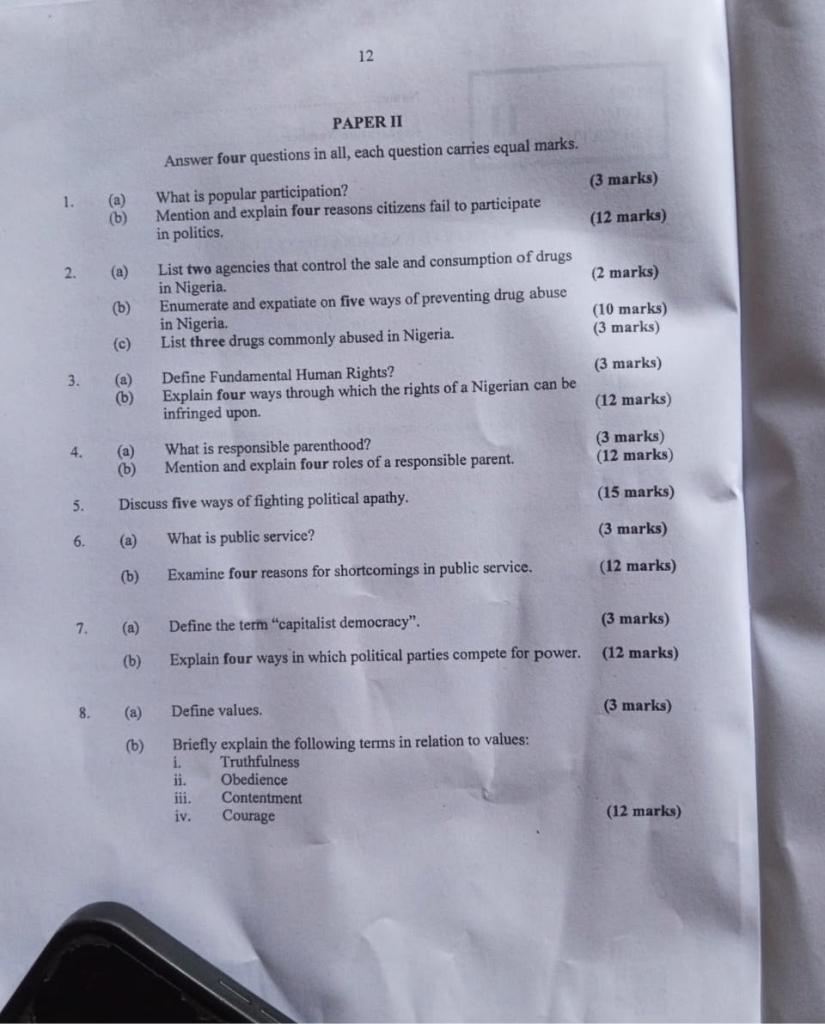
Number 1
(1a)
Popular participation is the active involvement of citizens in the political activities and decision-making processes of their country.
It includes voting during elections, joining political parties, attending political meetings, contesting for public office and expressing opinions on government policies.
(1b)
(PICK ANY FOUR)
(i) Political violence: Some citizens refuse to participate in politics because they fear intimidation, attacks, destruction of property or loss of life during political activities and elections.
(ii) Electoral malpractice: Rigging, vote buying, ballot-box snatching and falsification of results discourage citizens because they believe their votes will not count.
(iii) Lack of political education: Citizens who do not understand their political rights and responsibilities may not see the need to register, vote or take part in public affairs.
(iv) Poverty: Poor citizens may be more concerned with meeting their basic needs than participating in politics. Poverty also makes some people vulnerable to vote buying.
(v) Lack of trust in political leaders: Citizens may withdraw from politics when elected leaders fail to fulfil their promises or use public resources for personal benefit.
(vi) Corruption: Widespread corruption creates the impression that politics is dishonest and meant only for selfish individuals. This discourages responsible citizens from participating.
(vii) Religious and cultural restrictions: Some cultural practices or religious beliefs may prevent certain groups, especially women, from taking an active part in politics.
(viii) Fear of victimisation: Civil servants, workers and business owners may avoid political activities because they fear losing their jobs, contracts or other opportunities.
(ix) Illiteracy: People who cannot read or understand political information may find it difficult to follow election procedures or assess candidates and party programmes.
(x) Unfavourable government policies: Restrictions on freedom of speech, assembly and association may prevent citizens from participating freely in politics.
(xi) Poor performance of government: Unemployment, insecurity, bad roads and poor social services may make citizens lose interest and confidence in the political system.
(xii) Gender discrimination: Women may be discouraged by discrimination, harassment, lack of financial support and the belief that politics is mainly for men.
Number 2
(2a)
(i) National Drug Law Enforcement Agency (NDLEA).
(ii) National Agency for Food and Drug Administration and Control (NAFDAC).
(2b)
(PICK ANY FIVE)
(i) Public enlightenment: Government agencies, schools, religious bodies and the media should educate people about the harmful effects of drug abuse on their health, education, family and future.
(ii) Parental supervision: Parents should monitor the activities, friends and behaviour of their children. They should also guide them and discuss the dangers of drug abuse with them.
(iii) Enforcement of drug laws: The government should arrest and prosecute people who manufacture, sell, transport or possess illegal drugs. Strict enforcement will discourage others from engaging in the practice.
(iv) Control of drug sales: Pharmacies and medicine stores should sell controlled drugs only when a valid prescription is presented. Unlicensed drug sellers should be closed down.
(v) Rehabilitation of drug-dependent persons: Treatment and counselling centres should be provided to help people who are already addicted to drugs overcome dependence and return to normal life.
(vi) Avoidance of bad company: Young people should avoid friends and groups that encourage smoking, alcohol consumption and the use of illegal drugs.
(vii) Provision of employment and recreational facilities: Government should provide jobs, sports centres and skill-acquisition programmes to keep young people productively engaged.
(viii) School counselling: Schools should employ trained counsellors who can identify students at risk, advise them and provide early assistance before the problem becomes serious.
(ix) Responsible use of medicines: People should take medicines only according to the instructions of qualified health professionals and should not practise self-medication.
(x) Restriction of drug advertisements: Advertisements that encourage the careless use of alcohol, tobacco and medicines should be properly controlled.
(2c)
(PICK ANY THREE)
(i) Cannabis or marijuana.
(ii) Cocaine.
(iii) Heroin.
(iv) Tramadol.
(v) Codeine.
(vi) Alcohol.
Number 3
(3a)
Fundamental human rights are the basic freedoms and privileges which every person is entitled to enjoy by virtue of being human.
They are recognised and protected by the constitution and include the rights to life, dignity, personal liberty, fair hearing, freedom of expression, movement, religion and association.
(3b)
(PICK ANY FOUR)
(i) Unlawful arrest and detention: A person’s right to personal liberty is infringed when security agents arrest or detain the person without lawful reason, proper investigation or trial within the period allowed by law.
(ii) Extra-judicial killing: The right to life is violated when a person is deliberately killed by government agents, criminals or other individuals without being tried and sentenced by a competent court.
(iii) Torture and degrading treatment: Beating, torture, sexual abuse, inhuman punishment or humiliating treatment violates a person’s right to dignity.
(iv) Denial of fair hearing: A person’s right is infringed when the person is condemned, punished or imprisoned without being given an opportunity to defend himself or herself before an impartial court.
(v) Restriction of freedom of expression: Preventing citizens from expressing lawful opinions, criticising government policies or publishing information may violate their freedom of speech and the press.
(vi) Discrimination: Treating a person unfairly because of ethnic group, sex, religion, place of origin, disability or social status infringes the person’s right to freedom from discrimination.
(vii) Unlawful search and invasion of privacy: Entering a person’s home, reading private messages or searching personal property without legal authority may violate the right to privacy.
(viii) Restriction of movement: Preventing a citizen from travelling or living in any part of the country without a lawful reason infringes the right to freedom of movement.
(ix) Religious persecution: Forcing a person to practise a religion or preventing the person from observing his or her chosen religion violates freedom of thought, conscience and religion.
(x) Seizure of property without lawful compensation: Taking a person’s land, house or other property without following the law or paying adequate compensation violates the right to own property.
Number 4
(4a)
Responsible parenthood is the ability and willingness of parents to provide for the physical, emotional, moral, educational and social needs of their children.
It also involves properly guiding, protecting and training children to become responsible members of society.
(4b)
(PICK ANY FOUR)
(i) Provision of basic needs: Responsible parents provide food, clothing, shelter and other essential needs required for the healthy growth of their children.
(ii) Provision of education: Parents ensure that their children attend school, pay the necessary fees and provide books and other learning materials.
(iii) Moral upbringing: Responsible parents teach their children good values such as honesty, respect, discipline, hard work and obedience.
(iv) Protection of children: Parents protect their children from abuse, neglect, dangerous environments and harmful influences.
(v) Provision of healthcare: They ensure that their children receive proper medical care, immunisation, good nutrition and attention whenever they are ill.
(vi) Discipline and correction: Responsible parents correct unacceptable behaviour and establish reasonable rules that guide their children without using excessive punishment.
(vii) Emotional support: Parents show love, care and understanding. They listen to their children and help them deal with fear, stress and other emotional problems.
(viii) Proper supervision: Responsible parents monitor their children’s activities, friends, schoolwork and use of the internet to prevent harmful behaviour.
(ix) Socialisation: Parents teach their children how to relate peacefully with other people, respect elders and obey the laws of society.
(x) Setting good examples: Responsible parents behave in ways worthy of imitation because children often learn by copying the conduct of adults around them.
Number 5
(PICK ANY FIVE)
(i) Political education: Citizens should be educated about their political rights, responsibilities and the importance of voting. Civic education in schools, communities and the media helps people understand that their participation can influence government decisions.
(ii) Conduct of free and fair elections: Electoral bodies should organise credible elections in which votes are properly counted and results reflect the wishes of the people. When citizens believe that their votes will count, they are more willing to participate.
(iii) Prevention of electoral violence: Security agencies should protect voters, candidates and election officials before, during and after elections. Reducing intimidation, thuggery and ballot-box snatching will encourage citizens to participate without fear.
(iv) Good governance: Political leaders should provide security, employment, education, healthcare and other essential services. When citizens see the positive results of government, they are more likely to develop interest in political activities.
(v) Fulfilment of electoral promises: Elected representatives should keep the promises made during campaigns. Failure to fulfil promises causes disappointment and loss of confidence, while responsible leadership encourages continued participation.
(vi) Punishment of electoral offenders: Individuals involved in vote buying, election rigging, intimidation and destruction of election materials should be prosecuted. Proper punishment will protect the credibility of elections and restore public confidence.
(vii) Provision of adequate security: Government should ensure the safety of citizens during political meetings, campaigns and elections. People will participate more actively when they are protected from kidnapping, attacks and victimisation.
(viii) Encouragement of youth and women’s participation: Political parties and government should create opportunities for young people and women to contest elections and hold leadership positions. Discrimination and unfair barriers should be removed.
(ix) Reduction in the cost of political participation: Nomination forms and campaign expenses should be affordable. Excessively high costs prevent ordinary citizens from contesting elections and make politics appear to be only for wealthy individuals.
(x) Responsible mass media: Radio, television, newspapers and social media should provide accurate political information and give all political parties fair coverage. This enables citizens to make informed choices and increases their interest in public affairs.
Number 6
(6a)
Public service is the body of government ministries, departments and agencies through which government policies and programmes are carried out.
It is made up mainly of civil servants and other public officers who provide administrative and essential services to the people.
(6b)
(PICK ANY FOUR)
(i) Corruption: Some public officers demand bribes, divert public funds or use government property for personal benefit. This reduces efficiency and prevents public resources from being used for development.
(ii) Political interference: Politicians sometimes interfere in appointments, promotions and the implementation of policies. This may lead to favouritism and prevent qualified officers from performing their duties properly.
(iii) Inadequate funding: Many public institutions do not receive enough money to purchase equipment, maintain facilities or carry out their responsibilities effectively.
(iv) Poor remuneration: Low salaries and delayed payment of wages reduce workers’ motivation. Some officers may become careless or seek illegal ways of increasing their income.
(v) Shortage of qualified personnel: Some public offices lack enough trained and experienced workers. This may lead to poor service delivery and delays in completing official duties.
(vi) Bureaucratic delay: Excessive rules, paperwork and long administrative procedures make decision-making and service delivery slow.
(vii) Nepotism and favouritism: Appointments and promotions may be based on family relationships, ethnic background or personal connections instead of merit and competence.
(viii) Lack of modern equipment: Some offices depend on outdated machines and manual record-keeping systems. This slows down work and may result in the loss of important documents.
(ix) Poor attitude to work: Lateness, absenteeism, laziness and lack of commitment among some workers reduce the productivity of the public service.
(x) Inadequate training: Failure to organise regular training and retraining prevents workers from acquiring the modern knowledge and skills needed for their duties.
(xi) Overstaffing: Some public institutions employ more workers than they need, resulting in duplication of duties, waste of public funds and low productivity.
(xii) Lack of continuity in government policies: Frequent changes in government and policies may lead to the abandonment of projects and prevent the public service from achieving long-term goals.
Number 7
(7a)
Capitalist democracy is a system of government in which political power is obtained through free and periodic elections, while individuals and private organisations are allowed to own property and control businesses for profit.
It combines democratic principles such as popular participation, rule of law and majority choice with private ownership and a market economy.
(7b)
(PICK ANY FOUR)
(i) Election campaigns: Political parties organise rallies, meetings and public programmes to persuade voters to support their candidates. During campaigns, they explain their plans and promises to the electorate.
(ii) Presentation of candidates: Political parties nominate candidates to contest elections for positions such as president, governor and legislator. Each party tries to select popular, qualified and acceptable candidates who can win public support.
(iii) Publication of party manifestoes: Parties prepare manifestoes containing their proposed policies and programmes. They use these plans to convince citizens that they can govern better than their opponents.
(iv) Political debates: Candidates and party representatives participate in public debates where they discuss national issues and defend their policies. Debates allow voters to compare the knowledge and programmes of different parties.
(v) Use of the mass media: Political parties use radio, television, newspapers and social media to advertise their candidates and communicate their messages to voters.
(vi) Mobilisation of voters: Parties encourage citizens to register, obtain voter cards and vote during elections. Party members may visit homes and communities to gain more supporters.
(vii) Criticism of opposing parties: Political parties examine and criticise the policies, records and weaknesses of their opponents. They do this to show voters why the rival parties should not be elected.
(viii) Formation of alliances: Two or more political parties may form an alliance or coalition to increase their electoral strength and improve their chances of defeating a stronger opponent.
Number 8
(8a)
Values are the accepted principles, beliefs and standards which guide the behaviour, decisions and actions of individuals in society.
They help people to distinguish between what is right and what is wrong and promote peaceful and responsible living.
(8b)
(i) Truthfulness: Truthfulness is the habit of speaking and acting honestly without deception. A truthful person gives correct information, keeps promises and does not tell lies, cheat or hide important facts.
(ii) Obedience: Obedience is the willingness to follow lawful instructions, rules and constituted authority. It involves respecting parents, teachers, community leaders and government officials, provided their instructions do not violate the law or morality.
(iii) Contentment: Contentment is the state of being satisfied with what one has while making honest efforts to improve one’s condition. A contented person avoids greed, stealing, corruption and unhealthy competition.
(iv) Courage: Courage is the ability to face danger, fear, difficulty or opposition firmly. A courageous person stands for truth and justice, reports wrongdoing and performs necessary duties even when there is a risk or challenge.
COMPLETED!!!
TYPE B
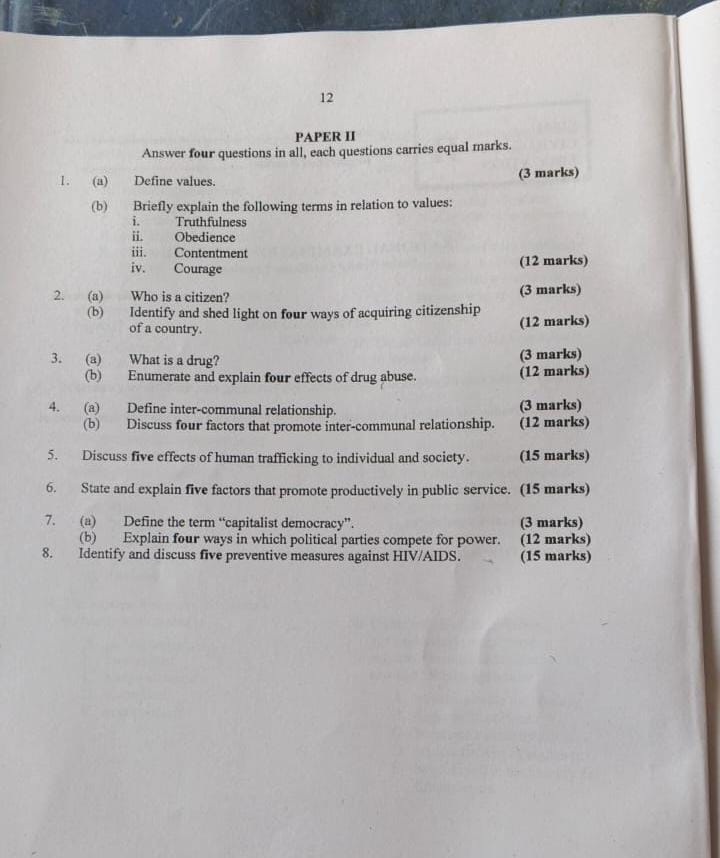
Number 1
(1a)
Values are the accepted beliefs, principles and standards that guide the behaviour, choices and actions of individuals in society.
They help people to distinguish between right and wrong and promote peaceful and responsible living.
(1b)
(i) Truthfulness: Truthfulness is the habit of speaking and acting honestly. A truthful person gives correct information, keeps promises and avoids lying, cheating or deceiving others.
(ii) Obedience: Obedience is the willingness to follow lawful instructions, rules and constituted authority. It involves respecting parents, teachers, community leaders and government officials.
(iii) Contentment: Contentment is the state of being satisfied with what one has while making honest efforts to improve one’s condition. It helps a person to avoid greed, stealing, corruption and unhealthy competition.
(iv) Courage: Courage is the ability to face fear, danger, difficulty or opposition firmly. A courageous person stands for truth and justice and does what is right even when there is a risk.
Number 2
(2a)
A citizen is a legally recognised member of a country who enjoys the rights and privileges provided by the state and performs duties such as obeying the law, paying taxes and defending the country.
(2b)
(i) Citizenship by birth: A person acquires citizenship by being born in a country or by being born to parents who are citizens of that country. The conditions depend on the constitution and laws of the country.
(ii) Citizenship by descent: A person may become a citizen of a country because one or both parents or grandparents are citizens of that country, even when the person is born outside the country.
(iii) Citizenship by registration: A foreigner may acquire citizenship by formally registering with the government. This may apply to a person married to a citizen or someone with close family connections to the country, provided the legal conditions are satisfied.
(iv) Citizenship by naturalisation: A foreigner who has lived in a country for the number of years required by law may apply for citizenship. The applicant may be required to have good character, obey the laws, understand the country’s language and show an intention to remain in the country.
Number 3
(3a)
A drug is any substance, other than food, which when taken into the body changes the normal functioning, behaviour or physical condition of the person.
Drugs may be used for medical treatment when prescribed properly, but they may become harmful when taken wrongly or excessively.
(3b)
(PICK ANY FOUR)
(i) Damage to health: Drug abuse may damage important organs such as the brain, liver, lungs, heart and kidneys. It may also cause weakness, loss of appetite and poor physical development.
(ii) Addiction: Continuous use of drugs may make the user physically or mentally dependent on them. The person may find it difficult to stop taking the drug even when it is causing serious harm.
(iii) Mental disorder: Drug abuse may cause anxiety, depression, hallucination, confusion, aggression or loss of memory. In severe cases, the person may become mentally unstable.
(iv) Poor academic performance: A student who abuses drugs may lose concentration, miss classes and perform poorly in examinations. It may eventually lead to withdrawal or expulsion from school.
(v) Criminal behaviour: Drug users may engage in stealing, violence, robbery or other crimes to obtain money for drugs. Some drugs may also make users aggressive and uncontrollable.
(vi) Breakdown of family relationships: Drug abuse may cause quarrels, loss of trust, neglect of responsibilities and separation among family members.
(vii) Accidents and death: Drugs may reduce judgment and coordination, leading to road accidents, workplace injuries, overdose or sudden death.
(viii) Loss of employment: A worker who abuses drugs may become absent, careless and unproductive. This may result in suspension or dismissal from work.
(ix) Financial hardship: Drug users may spend large amounts of money buying drugs, leaving little or nothing for food, education, shelter and other important needs.
(x) Spread of diseases: Sharing needles and other sharp objects while taking drugs may spread diseases such as HIV/AIDS and hepatitis.
Number 4
(4a)
Inter-communal relationship is the peaceful interaction and cooperation between two or more communities for their mutual benefit and development.
It involves respect, communication, trade, cultural exchange and joint efforts among neighbouring communities.
(4b)
(PICK ANY FOUR)
(i) Intermarriage: Marriage between people from different communities creates family ties and strengthens friendship. It reduces hatred and encourages peaceful coexistence.
(ii) Trade and commercial activities: Buying and selling between communities promote regular interaction and economic dependence. Communities are more likely to maintain peace when they benefit from one another.
(iii) Cultural festivals and sporting activities: Joint festivals, football competitions and other social events bring people together. They help members of different communities understand and appreciate one another’s culture.
(iv) Effective communication: Regular communication between community leaders and members helps to prevent misunderstanding. It also makes it easier to resolve disputes before they become serious.
(v) Peaceful settlement of disputes: Conflicts should be resolved through dialogue, negotiation, mediation and arbitration instead of violence. Fair settlement restores trust and promotes lasting peace.
(vi) Good leadership: Honest and responsible community leaders encourage tolerance, cooperation and respect. They prevent inflammatory statements and take quick action when problems arise.
(vii) Religious tolerance: Members of different religious groups should respect one another’s beliefs and freedom of worship. This reduces religious conflict and promotes unity.
(viii) Joint development projects: Communities can cooperate in providing roads, markets, schools, hospitals and water facilities. Such projects create shared interests and strengthen their relationship.
(ix) Respect for customs and traditions: People should avoid insulting or interfering with the lawful traditions of neighbouring communities. Mutual respect reduces tension and suspicion.
(x) Government intervention: Government agencies can organise peace meetings, provide security and establish clear boundaries between communities. This helps to prevent land and boundary disputes.
Number 5
(PICK ANY FIVE)
(i) Physical injury and poor health: Victims of human trafficking are often beaten, sexually abused, overworked and denied proper food or medical care. This may cause serious injuries, unwanted pregnancy, infections and permanent health problems.
(ii) Psychological and emotional trauma: Victims may suffer fear, depression, anxiety, shame and loss of self-confidence because of the violence, threats and humiliation they experience.
(iii) Loss of freedom and human dignity: Trafficked persons are controlled by their traffickers and may be forced to work, beg or engage in prostitution against their will. This violates their fundamental human rights and dignity.
(iv) Death and permanent disability: Some victims die while being transported under dangerous conditions or as a result of torture, disease and excessive labour. Others may suffer injuries that leave them permanently disabled.
(v) Loss of education and opportunities: Children and young people who are trafficked may be withdrawn from school. This prevents them from acquiring knowledge and skills and reduces their future employment opportunities.
(vi) Increase in crime: Human trafficking encourages crimes such as kidnapping, forgery, sexual exploitation, forced labour and money laundering. It therefore increases insecurity in society.
(vii) Breakdown of families: Families may be separated when their members are trafficked. Parents may lose their children, while victims who return home may find it difficult to rebuild relationships because of trauma and shame.
(viii) Spread of diseases: Sexual exploitation and unsafe living conditions may increase the spread of HIV/AIDS and other sexually transmitted infections among victims and members of society.
(ix) Loss of productive labour: Trafficking removes young and able-bodied people from useful education and legitimate employment. This reduces the productive workforce available for national development.
(x) Damage to the country’s reputation: A country known for widespread human trafficking may lose international respect and discourage tourists, investors and development partners.
Number 6
(PICK ANY FIVE)
(i) Adequate remuneration: Public servants should receive fair salaries, allowances and other benefits. Good pay motivates workers, reduces dissatisfaction and discourages bribery and corruption.
(ii) Regular training and retraining: Workers should be given opportunities to attend courses, seminars and workshops. This improves their knowledge, skills and ability to perform their duties effectively.
(iii) Provision of modern equipment: Public offices should be supplied with computers, vehicles, communication facilities and other necessary tools. Modern equipment makes work faster, easier and more accurate.
(iv) Promotion based on merit: Hardworking and qualified officers should be promoted according to competence, experience and performance. This encourages workers to remain committed and productive.
(v) Good working conditions: A safe and comfortable work environment, reasonable working hours and adequate office facilities improve the morale and efficiency of workers.
(vi) Effective supervision: Senior officers should regularly monitor the activities of workers and ensure that duties are properly performed. Poor performance should be corrected promptly.
(vii) Motivation and recognition: Outstanding workers should be rewarded through commendation, bonuses, awards and other incentives. Recognition encourages them and other workers to improve their performance.
(viii) Job security: Workers who perform their duties properly should be protected from unfair dismissal and political victimisation. Job security allows them to work confidently and remain committed.
(ix) Discipline: Rules concerning punctuality, attendance, honesty and proper conduct should be enforced. Workers who are lazy, absent or corrupt should face appropriate punishment.
(x) Adequate funding: Government ministries and agencies should receive enough funds to carry out their programmes, maintain equipment and provide efficient services to the public.
(xi) Proper division of labour: Duties should be assigned according to the training and ability of each worker. This reduces confusion, duplication of duties and waste of time.
(xii) Reduction of political interference: Politicians should not interfere unnecessarily in appointments, promotions and daily administration. Public servants should be allowed to perform their duties professionally.
Number 7
(7a)
Capitalist democracy is a system of government in which political leaders are chosen through free and periodic elections, while individuals and private organisations are allowed to own property and operate businesses for profit.
It combines democratic principles such as popular participation, rule of law and majority choice with private ownership and a market economy.
(7b)
(PICK ANY FOUR)
(i) Election campaigns: Political parties organise rallies, meetings and door-to-door campaigns to persuade voters to support their candidates. During campaigns, they explain their programmes and promises to the electorate.
(ii) Presentation of candidates: Political parties nominate candidates to contest elections for different political offices. Each party tries to select popular, qualified and acceptable candidates who can attract voters.
(iii) Publication of party manifestoes: Parties prepare manifestoes containing the policies and programmes they intend to carry out if elected. They use these plans to convince citizens that they can govern better than their opponents.
(iv) Political debates: Candidates and party representatives take part in public debates where they discuss national issues and defend their policies. This allows voters to compare the ideas and abilities of different parties.
(v) Use of the mass media: Political parties use radio, television, newspapers and social media to advertise their candidates and communicate their messages to the public.
(vi) Mobilisation of voters: Parties encourage citizens to register, obtain voter cards and vote during elections. Their members may visit homes and communities to gain more supporters.
(vii) Criticism of opposing parties: Political parties examine and criticise the policies, records and weaknesses of their opponents. They do this to persuade voters not to support rival parties.
(viii) Formation of alliances: Political parties may form alliances or coalitions with other parties to increase their electoral strength and improve their chances of winning power.
Number 8
(PICK ANY FIVE)
(i) Abstinence from sexual intercourse: Unmarried people should avoid sexual intercourse because abstinence prevents exposure to HIV through sexual contact.
(ii) Faithfulness to one uninfected partner: Married partners should remain faithful to each other. Avoiding multiple sexual partners reduces the risk of contracting HIV.
(iii) Proper use of condoms: People who are sexually active should use condoms correctly and consistently. Condoms reduce contact with infected body fluids during sexual intercourse.
(iv) Screening of blood before transfusion: All donated blood should be properly tested for HIV before it is given to a patient. This prevents transmission through infected blood.
(v) Avoidance of shared sharp objects: Needles, syringes, blades, clippers and other sharp objects should not be shared because they may carry infected blood.
(vi) Use of sterilised medical instruments: Hospitals, clinics and laboratories should sterilise or properly dispose of instruments after use to prevent the transfer of infected blood.
(vii) HIV testing and counselling: People should know their HIV status through voluntary testing. Early detection enables infected persons to receive treatment and take precautions to avoid transmitting the virus.
(viii) Public enlightenment: Government agencies, schools, religious bodies and the media should educate people about the causes, modes of transmission and prevention of HIV/AIDS.
(ix) Prevention of mother-to-child transmission: Pregnant women should undergo HIV testing and receive appropriate medical treatment when necessary. This reduces transmission to the baby during pregnancy, delivery or breastfeeding.
(x) Avoidance of intravenous drug abuse: People should not inject illegal drugs or share needles and syringes. Shared injecting equipment can transmit HIV through infected blood.
COMPLETED!!!
TYPE C
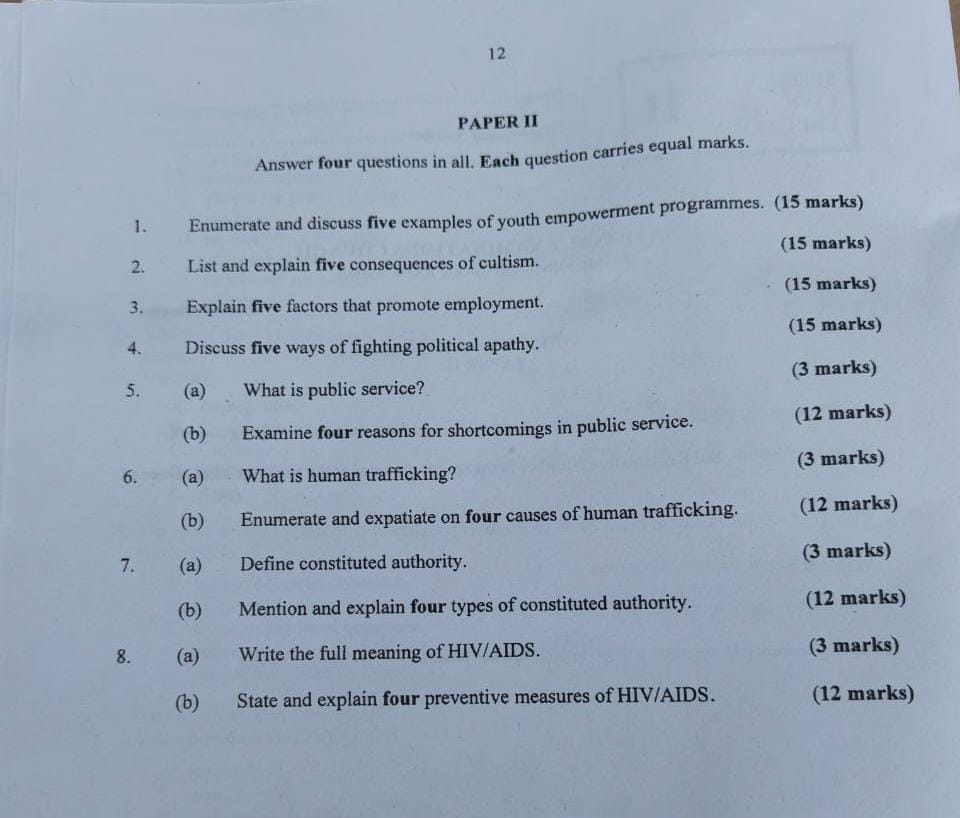
Number 1
(PICK ANY FIVE)
(i) Vocational and skills-acquisition programmes: These programmes train young people in practical occupations such as tailoring, carpentry, welding, hairdressing, plumbing, catering and automobile repair. The skills acquired enable them to become self-employed and earn a living.
(ii) Entrepreneurship training programmes: Young people are taught how to identify business opportunities, prepare business plans, manage money and operate small businesses. Such training helps them establish enterprises and employ other people.
(iii) Agricultural empowerment programmes: Youths are provided with training, improved seedlings, fertilisers, farm tools, livestock and access to farmland. This encourages them to engage in farming, increases food production and reduces unemployment.
(iv) Information and Communication Technology programmes: These programmes train youths in computer operation, coding, website design, digital marketing, graphics design and data processing. ICT skills improve their employment opportunities and enable them to work online.
(v) Youth credit and loan schemes: Government agencies, banks and organisations provide loans or grants to young entrepreneurs. The money helps them establish or expand businesses, purchase equipment and create employment.
(vi) Apprenticeship programmes: Young people are attached to experienced artisans or business owners to learn a trade through practical experience. After completing the training, they may receive tools or financial assistance to begin their own businesses.
(vii) Employment and job-placement programmes: These programmes connect qualified youths with available job opportunities in public institutions and private companies. They may also provide internships that help young people gain work experience.
(viii) Sports development programmes: Young people are trained in football, athletics, boxing and other sports. Talented participants may become professional athletes, coaches or sports officials and earn income from their abilities.
(ix) Leadership and civic education programmes: These programmes teach youths leadership skills, responsibility, peaceful coexistence and participation in community development. They prepare young people to become responsible leaders and active citizens.
(x) Cooperative youth programmes: Young people with similar economic interests form cooperative societies to save money, obtain loans and carry out joint business activities. Working together makes it easier for them to acquire equipment and market their products.
Number 2
(PICK ANY FIVE)
(i) Loss of lives: Cult activities often involve violent clashes, attacks and revenge killings. Members, students and innocent persons may lose their lives during such conflicts.
(ii) Destruction of property: Cultists may destroy houses, school facilities, vehicles and business premises during attacks. This causes financial loss to individuals, institutions and government.
(iii) Disruption of academic activities: Cultism may lead to the suspension of lectures, closure of schools and cancellation of examinations. This affects the academic progress of students.
(iv) Expulsion and imprisonment: Students involved in cultism may be suspended or expelled from school. They may also be arrested, prosecuted and imprisoned for crimes committed by their group.
(v) Fear and insecurity: Cult activities create fear among students, teachers and members of the public. People may become afraid to attend school, work or social activities.
(vi) Poor academic performance: Cult members may spend more time attending secret meetings, fighting and carrying out illegal activities than studying. This may lead to failure in examinations.
(vii) Increase in crime: Cult groups may engage in armed robbery, rape, kidnapping, murder, drug abuse and other criminal activities. This increases insecurity in society.
(viii) Injury and permanent disability: Cult clashes may result in serious injuries from guns, knives, acid and other dangerous weapons. Some victims may become permanently disabled.
(ix) Bad reputation: A person identified as a cultist may lose the trust and respect of family members, employers, teachers and society. This may affect future education and employment opportunities.
(x) Breakdown of peace and order: Cultism promotes hatred, violence and revenge among rival groups. This destroys peaceful coexistence in schools and communities.
Number 3
(PICK ANY FIVE)
(i) Industrial development: Establishment and expansion of industries create jobs for engineers, technicians, factory workers, drivers, accountants and other categories of workers.
(ii) Agricultural development: Government support for farming through loans, fertilisers, improved seedlings, irrigation and modern equipment creates employment in crop production, livestock farming, fishing and agricultural processing.
(iii) Skill-acquisition programmes: Training people in trades such as tailoring, welding, carpentry, plumbing, catering and computer operation enables them to become self-employed and employ others.
(iv) Provision of credit facilities: Affordable loans and grants help individuals and businesses to establish or expand enterprises. Business expansion leads to the employment of more workers.
(v) Stable electricity supply: Reliable power reduces the cost of production and encourages industries and small businesses to operate successfully. This promotes business expansion and job creation.
(vi) Good transportation facilities: Good roads, railways, airports and seaports make it easier to move people, raw materials and finished goods. This encourages investment and creates employment.
(vii) Favourable government policies: Policies such as tax reduction, investment incentives and support for local production encourage entrepreneurs and companies to establish businesses and employ workers.
(viii) Political stability and security: A peaceful and secure environment attracts local and foreign investors. New investments lead to the establishment of industries and creation of employment opportunities.
(ix) Improvement in education: Quality education equips people with the knowledge and qualifications required for available jobs. Vocational and technical education also prepares people for practical occupations.
(x) Promotion of entrepreneurship: Teaching people how to identify business opportunities, prepare business plans and manage enterprises encourages self-employment and reduces dependence on government jobs.
Number 4
(PICK ANY FIVE)
(i) Political education: Citizens should be educated about their political rights, duties and the importance of participating in elections and other political activities. This helps them understand that their involvement can influence government decisions.
(ii) Conduct of free and fair elections: Electoral bodies should organise credible elections in which votes are properly counted and results reflect the wishes of the people. Citizens are more willing to participate when they believe their votes will count.
(iii) Prevention of electoral violence: Security agencies should protect voters, candidates and election officials during political activities. Reducing intimidation, thuggery and attacks will encourage people to participate without fear.
(iv) Good governance: Political leaders should provide security, employment, education, healthcare and other essential services. Good performance by government increases public confidence and interest in politics.
(v) Fulfilment of electoral promises: Elected leaders should carry out the programmes and promises made during campaigns. Failure to do so causes disappointment and discourages future participation.
(vi) Punishment of electoral offenders: People involved in election rigging, vote buying, intimidation and ballot-box snatching should be prosecuted. Proper punishment will restore confidence in the political system.
(vii) Provision of adequate security: Government should ensure the safety of citizens during campaigns, political meetings and elections. People will participate more actively when their lives and property are protected.
(viii) Encouragement of youth and women’s participation: Political parties should give young people and women equal opportunities to contest elections and hold leadership positions. This will make politics more inclusive.
(ix) Reduction in the cost of political participation: Nomination forms and campaign expenses should be made affordable. Excessive costs prevent ordinary citizens from contesting elections and make politics appear to be only for wealthy people.
(x) Responsible use of the mass media: Radio, television, newspapers and social media should provide accurate political information and give fair coverage to political parties. This enables citizens to make informed choices.
Number 5
(5a)
Public service is the body of government ministries, departments and agencies through which government policies and programmes are implemented and essential services are provided to the people.
It is made up mainly of civil servants and other public officers employed by the government.
(5b)
(PICK ANY FOUR)
(i) Corruption: Some public officers demand bribes, divert public funds or use government property for personal benefit. This reduces efficiency and prevents public resources from being used for development.
(ii) Political interference: Politicians may interfere in appointments, promotions and the implementation of policies. This can lead to favouritism and prevent qualified officers from performing their duties properly.
(iii) Inadequate funding: Many public institutions do not receive enough money to purchase equipment, maintain facilities or carry out their responsibilities effectively.
(iv) Poor remuneration: Low salaries and delayed payment of wages reduce workers’ motivation. Some officers may become careless or engage in corrupt practices.
(v) Shortage of qualified personnel: Some public offices lack enough trained and experienced workers. This may lead to poor service delivery and delays in carrying out official duties.
(vi) Bureaucratic delay: Excessive rules, paperwork and long administrative procedures make decision-making and service delivery slow.
(vii) Nepotism and favouritism: Appointments and promotions may be based on family ties, ethnic background or personal connections instead of merit and competence.
(viii) Lack of modern equipment: Some offices still depend on outdated machines and manual record-keeping systems. This slows down work and may result in the loss of important documents.
(ix) Poor attitude to work: Lateness, absenteeism, laziness and lack of commitment among some workers reduce productivity in the public service.
(x) Inadequate training: Failure to provide regular training and retraining prevents workers from acquiring the modern knowledge and skills needed for their duties.
Number 6
(6a)
Human trafficking is the illegal recruitment, transportation, transfer or harbouring of people through force, deception or coercion for the purpose of exploitation.
Victims may be exploited through forced labour, prostitution, slavery, begging or removal of organs.
(6b)
(PICK ANY FOUR)
(i) Poverty: Poor families may be unable to provide food, education and other basic needs. Traffickers take advantage of this condition by promising victims jobs, money or a better life.
(ii) Unemployment: Lack of job opportunities makes many young people desperate to earn a living. They may accept false employment offers from traffickers and later become exploited.
(iii) Greed and desire for quick wealth: Some people engage in human trafficking because they want to make large amounts of money quickly. They treat victims as commodities for personal profit.
(iv) Lack of education: People with little or no education may not understand the dangers of trafficking or recognise false promises. This makes them easier to deceive.
(v) Broken homes: Children from unstable families may lack proper care, protection and guidance. They can easily be persuaded or forced into trafficking.
(vi) Ignorance: Some parents and victims do not know the true intentions of traffickers. They may believe promises of education, marriage or employment abroad.
(vii) Corruption: Corrupt officials may collect bribes and allow traffickers to cross borders, obtain false documents or escape punishment. This encourages the crime to continue.
(viii) Peer pressure: Young people may be influenced by friends who claim to have found good opportunities in other places. They may follow them without proper investigation.
(ix) Demand for cheap labour and prostitution: The demand for domestic servants, factory workers, farm workers and commercial sex workers encourages traffickers to recruit and exploit vulnerable persons.
(x) Weak enforcement of laws: When anti-trafficking laws are not properly enforced and offenders are not punished, traffickers continue their activities without fear.
Number 7
(7a)
Constituted authority is a person, group or institution legally or traditionally recognised and empowered to make decisions, give orders and ensure obedience within a society or organisation.
(7b)
(i) Traditional authority: This authority is exercised by traditional rulers such as kings, chiefs, emirs and village heads. They preserve customs, settle disputes and maintain peace within their communities.
(ii) Religious authority: This is exercised by religious leaders such as pastors, priests, imams and traditional religious leaders. They guide their followers on religious and moral matters.
(iii) Governmental authority: This authority is exercised by elected or appointed government officials such as the president, governors, lawmakers, judges and local government chairmen. They make and enforce laws and administer the affairs of the state.
(iv) Organisational authority: This authority exists within formal organisations and institutions. Examples include school principals, company managers, heads of departments and leaders of associations who direct activities and ensure that rules are obeyed.
Number 8
(8a)
HIV means Human Immunodeficiency Virus.
AIDS means Acquired Immune Deficiency Syndrome.
(8b)
(PICK ANY FOUR)
(i) Abstinence from sexual intercourse: Unmarried people should avoid sexual intercourse because this prevents exposure to HIV through sexual contact.
(ii) Faithfulness to one uninfected partner: Married partners should remain faithful to each other and avoid multiple sexual partners. This reduces the risk of contracting HIV.
(iii) Correct use of condoms: Sexually active persons should use condoms correctly and consistently. Condoms reduce contact with infected body fluids during sexual intercourse.
(iv) Screening of blood before transfusion: All donated blood should be properly tested for HIV before it is given to a patient. This prevents infection through contaminated blood.
(v) Avoidance of shared sharp objects: People should not share needles, syringes, razor blades, clippers and other sharp objects because they may carry infected blood.
(vi) Use of sterilised medical instruments: Hospitals and clinics should sterilise instruments properly or use disposable ones to prevent the transfer of infected blood.
(vii) HIV testing and counselling: People should undergo regular HIV testing to know their status. Early detection helps infected persons receive treatment and avoid spreading the virus.
(viii) Prevention of mother-to-child transmission: Pregnant women should be tested for HIV and receive proper medical treatment when necessary. This reduces transmission to the baby during pregnancy, delivery or breastfeeding.
COMPLETED!!!
TYPE D
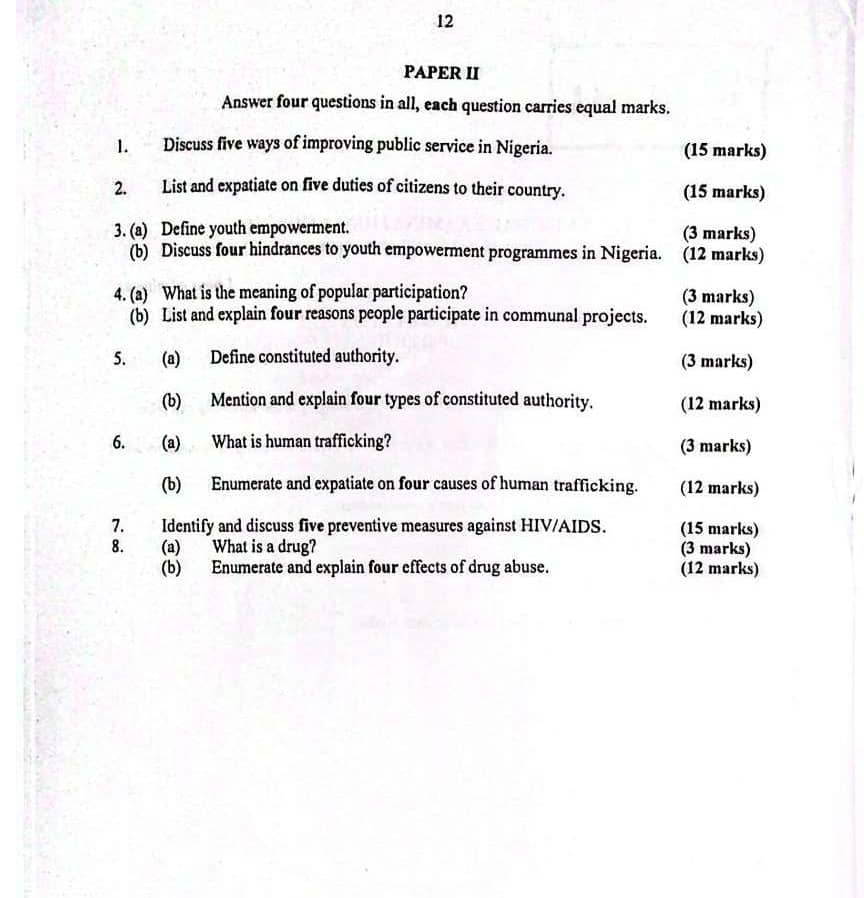
Number 1
(PICK ANY FIVE)
(i) Adequate remuneration: Public servants should be paid reasonable salaries, allowances and other benefits regularly. Good pay improves their morale and reduces the temptation to engage in bribery and corruption.
(ii) Regular training and retraining: Workers should attend seminars, workshops and professional courses to improve their knowledge and skills. This enables them to perform their duties more effectively.
(iii) Provision of modern equipment: Government offices should be supplied with computers, vehicles, communication facilities and other necessary tools. Modern equipment makes work faster, easier and more accurate.
(iv) Recruitment and promotion based on merit: Employment and promotion should be based on qualification, competence, experience and performance rather than tribalism, favouritism or political connection.
(v) Adequate funding: Government ministries, departments and agencies should receive enough funds to carry out their programmes, maintain facilities and provide efficient services to the public.
(vi) Effective supervision: Senior officers should regularly monitor the activities of workers and ensure that assigned duties are properly performed. Weaknesses should be identified and corrected promptly.
(vii) Enforcement of discipline: Rules concerning punctuality, attendance, honesty and proper conduct should be strictly enforced. Lazy, absent and corrupt officers should receive appropriate punishment.
(viii) Improvement of working conditions: Public servants should be provided with safe offices, reasonable working hours, suitable furniture and necessary welfare facilities. A good working environment increases productivity.
(ix) Reduction of political interference: Politicians should not interfere unnecessarily in appointments, promotions and the daily activities of public institutions. Officers should be allowed to perform their duties professionally.
(x) Use of digital technology: Government services and records should be computerised to reduce paperwork, delays and loss of documents. Digital systems also improve transparency and service delivery.
(xi) Reward for hard work: Outstanding public servants should be recognised through awards, bonuses, commendations and promotions. Such rewards encourage workers to remain dedicated.
(xii) Fight against corruption: Anti-corruption laws should be strictly enforced, while public funds and government property should be properly monitored. Corrupt officers should be prosecuted and punished.
Number 2
(PICK ANY FIVE)
(i) Obedience to laws: Citizens must obey the laws and regulations of the country. This helps to maintain peace, order and security in society.
(ii) Payment of taxes: Citizens should pay taxes and other lawful levies to the government. The revenue is used to provide roads, schools, hospitals, electricity and other public services.
(iii) Voting during elections: Eligible citizens should register and vote for candidates of their choice. This enables them to participate in choosing responsible leaders.
(iv) Protection of public property: Citizens should protect government buildings, roads, schools, electricity facilities and other public property from damage and misuse.
(v) Defence of the country: Citizens should be ready to defend their country against internal and external threats. They may serve in the armed forces or assist security agencies when necessary.
(vi) Respect for constituted authority: Citizens should respect lawful leaders and public officials while performing their duties. This promotes order and effective administration.
(vii) Reporting crimes: Citizens should report criminal activities and suspicious movements to the appropriate security agencies. This helps to reduce crime and protect lives and property.
(viii) Promotion of national unity: Citizens should tolerate people from different ethnic, religious and cultural backgrounds. They should avoid actions that may cause hatred or division.
(ix) Participation in community development: Citizens should take part in sanitation exercises, meetings and development projects. Their participation improves the condition of their communities.
(x) Loyalty to the country: Citizens should show love, commitment and faithfulness to their country. They should protect its good name and avoid actions that can damage national interest.
(xi) Respect for the rights of others: Citizens should respect the freedom, property and dignity of other people. This encourages peaceful coexistence.
(xii) Honest performance of duties: Citizens should carry out their work responsibly and honestly, whether in public or private employment. This contributes to national development.
Number 3
(3a)
Youth empowerment is the process of providing young people with the knowledge, skills, resources and opportunities needed to become self-reliant, productive and useful members of society.
(3b)
(PICK ANY FOUR)
(i) Inadequate funding: Many youth empowerment programmes do not receive enough money to purchase equipment, pay trainers or support participants after training.
(ii) Corruption and mismanagement: Funds and materials meant for youth programmes may be diverted or misused by officials, thereby preventing the programmes from achieving their objectives.
(iii) Political interference: Beneficiaries may be selected based on political connections, party membership or favouritism instead of genuine need and qualification.
(iv) Lack of qualified trainers: Some programmes employ inexperienced or unqualified instructors. This prevents participants from acquiring useful and practical skills.
(v) Inadequate training facilities: Shortage of workshops, computers, tools, classrooms and other necessary equipment reduces the quality of training given to young people.
(vi) Poor planning: Some programmes are introduced without proper research, clear objectives or knowledge of the actual needs of the youths. This may make the training irrelevant.
(vii) Lack of continuity: A new government may abandon empowerment programmes started by a previous administration. This prevents participants from completing their training or receiving promised support.
(viii) Low level of awareness: Many young people are not properly informed about available empowerment opportunities. As a result, they may fail to register or participate.
(ix) Rural neglect: Most programmes are concentrated in urban areas, making it difficult for youths in rural communities to benefit.
(x) Lack of start-up capital: After completing their training, many youths are not given loans, grants or tools to establish their own businesses. This makes the acquired skills less useful.
Number 4
(4a)
Popular participation is the active involvement of citizens in the political, social and economic activities of their community or country.
It allows people to contribute to decisions and programmes that affect their lives.
(4b)
(PICK ANY FOUR)
(i) Desire for community development: People participate in communal projects to improve their community through the provision of roads, schools, markets, water and health centres.
(ii) Sense of belonging: Participation makes individuals feel that they are recognised members of the community and have a responsibility towards its progress.
(iii) Provision of essential amenities: Citizens may take part in projects when government has failed to provide basic facilities such as electricity, clean water and good roads.
(iv) Promotion of unity: Communal projects bring people together to work towards a common goal. This strengthens cooperation, friendship and peaceful coexistence.
(v) Personal and collective benefits: People participate because completed projects will benefit them, their families and other members of the community.
(vi) Improvement of security: Community members may contribute money, information or labour to security projects in order to protect lives and property.
(vii) Preservation of community property: People participate to build, repair and maintain public facilities so that they can remain useful for a long time.
(viii) Recognition and respect: Some people participate because active members are respected, appreciated and may be considered for leadership positions.
(ix) Creation of employment: Communal projects may provide temporary or permanent jobs for artisans, labourers and other members of the community.
(x) Civic responsibility: Responsible citizens understand that they have a duty to contribute their time, money, ideas and labour to the development of their community.
Number 5
(5a)
Constituted authority is a person, group or institution legally or traditionally recognised and given the power to make decisions, give orders and ensure obedience in society.
(5b)
(PICK ANY FOUR)
(i) Traditional authority: This authority is exercised by traditional rulers such as kings, chiefs, emirs and village heads. They preserve customs, settle disputes and maintain peace in their communities.
(ii) Religious authority: This is exercised by religious leaders such as pastors, priests, imams and traditional religious leaders. They guide their followers on religious and moral matters.
(iii) Governmental authority: This authority is exercised by elected or appointed government officials such as the president, governors, lawmakers, judges and local government chairmen. They make and enforce laws and administer the affairs of the country.
(iv) Organisational authority: This authority exists within formal organisations and institutions. Examples include school principals, company managers, heads of departments and leaders of associations who direct activities and ensure that rules are obeyed.
(v) Parental authority: This is the authority exercised by parents over their children. Parents provide guidance, discipline and protection and ensure that children behave responsibly.
(vi) School authority: This authority is exercised by principals, teachers and other school officials. They maintain discipline, enforce school rules and direct academic activities.
Number 6
(6a)
Human trafficking is the illegal recruitment, transportation, transfer or harbouring of people through force, deception or coercion for the purpose of exploitation.
Victims may be exploited through forced labour, prostitution, slavery, begging or removal of organs.
(6b)
(PICK ANY FOUR)
(i) Poverty: Poor families may be unable to provide food, education and other basic needs. Traffickers take advantage of this condition by promising victims jobs, money or a better life.
(ii) Unemployment: Lack of job opportunities makes many young people desperate to earn a living. They may accept false employment offers from traffickers and later become exploited.
(iii) Greed and desire for quick wealth: Some people engage in human trafficking because they want to make large amounts of money quickly. They treat victims as commodities for personal profit.
(iv) Lack of education: People with little or no education may not understand the dangers of trafficking or recognise false promises. This makes them easier to deceive.
(v) Broken homes: Children from unstable families may lack proper care, protection and guidance. They can easily be persuaded or forced into trafficking.
(vi) Ignorance: Some parents and victims do not know the true intentions of traffickers. They may believe promises of education, marriage or employment abroad.
(vii) Corruption: Corrupt officials may collect bribes and allow traffickers to cross borders, obtain false documents or escape punishment. This encourages the crime to continue.
(viii) Peer pressure: Young people may be influenced by friends who claim to have found good opportunities in other places. They may follow them without proper investigation.
(ix) Demand for cheap labour and prostitution: The demand for domestic servants, farm workers, factory workers and commercial sex workers encourages traffickers to recruit and exploit vulnerable persons.
(x) Weak enforcement of laws: When anti-trafficking laws are not properly enforced and offenders are not punished, traffickers continue their activities without fear.
Number 7
(PICK ANY FIVE)
(i) Abstinence from sexual intercourse: Unmarried people should avoid sexual intercourse because abstinence prevents exposure to HIV through sexual contact.
(ii) Faithfulness to one uninfected partner: Married partners should remain faithful to each other and avoid multiple sexual partners. This reduces the risk of contracting HIV.
(iii) Correct use of condoms: Sexually active persons should use condoms correctly and consistently. Condoms reduce contact with infected body fluids during sexual intercourse.
(iv) Screening of blood before transfusion: All donated blood should be properly tested for HIV before it is given to a patient. This prevents transmission through infected blood.
(v) Avoidance of shared sharp objects: People should not share needles, syringes, razor blades, clippers and other sharp objects because they may carry infected blood.
(vi) Use of sterilised medical instruments: Hospitals, clinics and laboratories should sterilise instruments properly or use disposable ones to prevent the transfer of infected blood.
(vii) HIV testing and counselling: People should undergo regular HIV testing to know their status. Early detection helps infected persons receive treatment and avoid transmitting the virus to others.
(viii) Prevention of mother-to-child transmission: Pregnant women should be tested for HIV and receive proper medical treatment when necessary. This reduces transmission to the baby during pregnancy, delivery or breastfeeding.
(ix) Public enlightenment: Government agencies, schools, religious organisations and the media should educate people about the causes, modes of transmission and prevention of HIV/AIDS.
(x) Avoidance of intravenous drug abuse: People should not inject illegal drugs or share needles and syringes. Shared injecting equipment can transmit HIV through infected blood.
Number 8
(8a)
A drug is any substance, other than food, which changes the normal functioning of the body or mind when taken.
Drugs may be used for medical purposes, but they become harmful when they are misused or taken without proper prescription.
(8b)
(PICK ANY FOUR)
(i) Damage to health: Drug abuse can damage important organs such as the brain, heart, liver and kidneys. It may also weaken the body and cause serious illness.
(ii) Addiction: A drug abuser may become physically or mentally dependent on drugs and find it difficult to stop using them.
(iii) Mental disorder: Drug abuse may cause anxiety, depression, hallucination, confusion and other mental health problems.
(iv) Poor academic performance: Students who abuse drugs may lose concentration, miss classes and perform poorly in examinations.
(v) Increase in crime: Drug abusers may engage in stealing, robbery, violence and other crimes in order to obtain money to buy drugs.
(vi) Accidents and death: Drugs may affect judgement and coordination, leading to road accidents, injuries, overdose and death.
(vii) Family breakdown: Drug abuse may cause quarrels, neglect of responsibilities and loss of trust among family members.
(viii) Loss of employment: A drug abuser may become careless, absent from work or unable to perform duties effectively, which may lead to dismissal.
(ix) Financial problems: Drug abusers may spend large amounts of money on drugs and become unable to meet their basic needs.
(x) Spread of diseases: Sharing needles and syringes may spread HIV/AIDS, hepatitis and other blood-borne diseases.
COMPLETED!!!
TYPE E
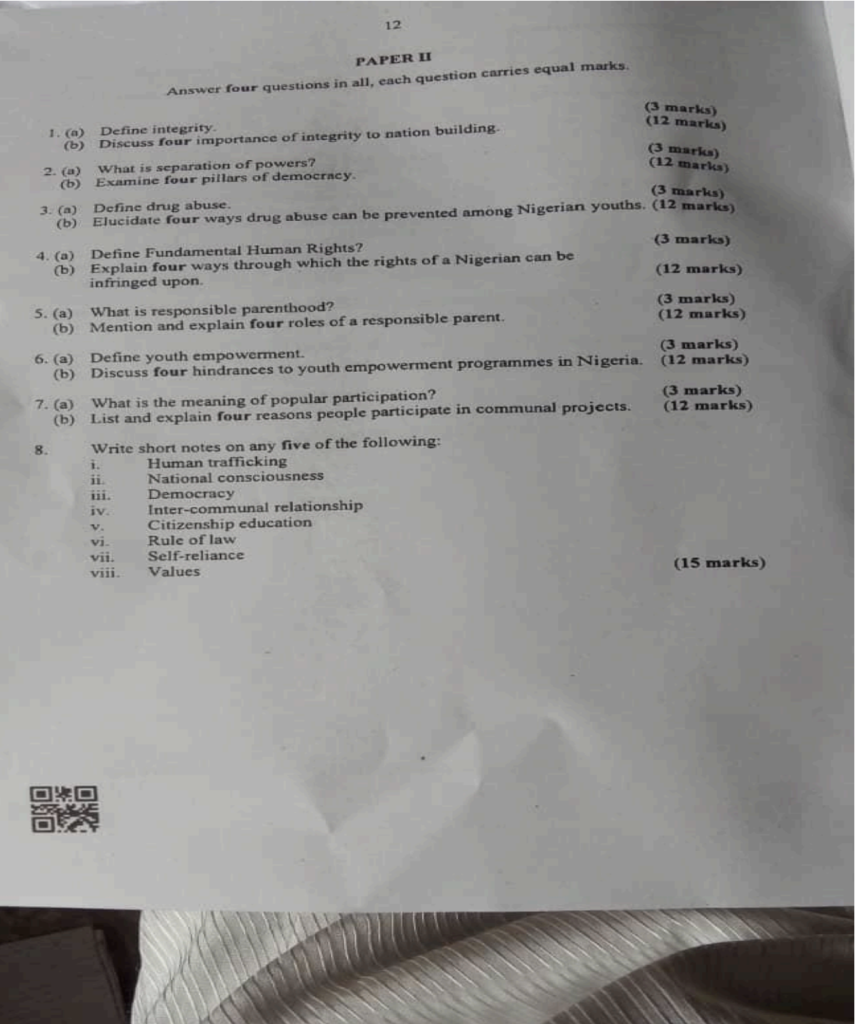
Number 1
(1a)
Integrity is the quality of being honest, upright and morally responsible in one’s actions, words and decisions, even when no one is watching.
(1b)
(PICK ANY FOUR)
(i) Promotion of good leadership: Leaders with integrity use public resources honestly and make decisions in the interest of the people. This promotes effective governance and national development.
(ii) Reduction of corruption: Integrity discourages bribery, embezzlement, fraud and misuse of public funds. Resources meant for development can therefore be properly used.
(iii) Building of public trust: When citizens and leaders behave honestly, people develop confidence in government institutions and one another. This strengthens cooperation in the country.
(iv) Promotion of justice and fairness: Integrity encourages people in authority to treat citizens equally and make decisions without favouritism, tribalism or discrimination.
(v) Proper use of national resources: Honest public officers protect government property and ensure that money meant for roads, schools, hospitals and other projects is not diverted.
(vi) Attraction of investment: A country known for honesty, accountability and respect for agreements attracts local and foreign investors. This creates employment and increases economic growth.
(vii) Promotion of peace and unity: People with integrity avoid lies, betrayal and dishonest practices that can create conflict. This promotes peaceful coexistence among citizens.
(viii) Increase in productivity: Workers who are honest and responsible perform their duties diligently. This improves the quality of services and contributes to national progress.
(ix) Strengthening of democratic institutions: Integrity in elections, law enforcement and public administration ensures that institutions operate according to the constitution and the rule of law.
(x) Improvement of the country’s image: A nation whose citizens and leaders are known for honesty earns respect and trust from other countries and international organisations.
Number 2
(2a)
Separation of powers is the division of governmental powers and functions among the legislature, executive and judiciary.
It ensures that no single arm of government controls all powers and that each arm performs its constitutional duties independently.
(2b)
(PICK ANY FOUR)
(i) The legislature: The legislature makes laws for the country, approves public expenditure and checks the activities of the executive. It also represents the interests of the people.
(ii) The executive: The executive implements laws and government policies. It maintains law and order, protects the country and manages the daily administration of the state.
(iii) The judiciary: The judiciary interprets laws and settles disputes. It protects the rights of citizens and ensures that government actions conform to the constitution.
(iv) Free and fair elections: Democratic leaders must be chosen through regular, credible and peaceful elections. Citizens should be free to vote for candidates of their choice without intimidation or manipulation.
(v) Rule of law: Everyone, including government officials, must obey the law. No person should be punished except according to the law, and all citizens should be treated equally.
(vi) Fundamental human rights: Democracy protects rights such as freedom of speech, movement, association, religion and the right to fair hearing.
(vii) Independent mass media: The media informs and educates citizens, exposes wrongdoing and provides a platform for different opinions. It also helps to hold government accountable.
(viii) Political parties: Political parties present candidates, formulate policies and provide citizens with choices during elections. Opposition parties also monitor and criticise the government.
Number 3
(3a)
Drug abuse is the improper or excessive use of drugs without medical prescription or for purposes other than those for which they are meant.
It also includes taking illegal drugs or using prescribed drugs in the wrong quantity.
(3b)
(PICK ANY FOUR)
(i) Public enlightenment: Government agencies, schools, religious bodies and the media should educate young people about the dangers and consequences of drug abuse.
(ii) Parental guidance and supervision: Parents should monitor the activities, friends and behaviour of their children. They should also teach them good morals and provide proper counselling.
(iii) Strict enforcement of drug laws: Law enforcement agencies should arrest and prosecute people who produce, sell or distribute illegal drugs. This will reduce the availability of harmful substances.
(iv) Restriction of access to drugs: Pharmacies and medicine sellers should not sell controlled drugs without a valid prescription. Proper monitoring will prevent youths from obtaining drugs easily.
(v) Provision of employment opportunities: Government and private organisations should create jobs and skill-acquisition programmes for young people. Productive engagement reduces idleness and frustration that may lead to drug abuse.
(vi) Good peer influence: Youths should be encouraged to choose responsible friends and avoid groups that promote smoking, drinking and the use of illegal drugs.
(vii) School counselling programmes: Schools should provide trained counsellors who can identify, advise and support students who are at risk of abusing drugs.
(viii) Rehabilitation of drug-dependent youths: Treatment and rehabilitation centres should be provided for young people who are already addicted. This helps them recover and return to normal life.
(ix) Promotion of recreational activities: Sports, clubs, debates and other useful activities should be encouraged to keep youths occupied and help them develop healthy interests.
(x) Responsible advertising: Advertisements that encourage the use of alcohol, tobacco and harmful substances should be properly controlled, especially those directed at young people.
Number 4
NUMBER 4
(4a)
Fundamental human rights are the basic freedoms and privileges guaranteed to every citizen by the constitution.
They include the rights to life, personal liberty, fair hearing, dignity, movement, expression, association and freedom from discrimination.
(4b)
(PICK ANY FOUR)
(i) Unlawful arrest and detention: A citizen’s right to personal liberty is infringed when the person is arrested or detained without a lawful reason or kept in custody beyond the period allowed by law.
(ii) Denial of fair hearing: A citizen’s right is violated when the person is punished or convicted without being given an opportunity to present a defence before an impartial court.
(iii) Torture and inhuman treatment: Beating, humiliating or treating a person cruelly violates the individual’s right to dignity and freedom from inhuman treatment.
(iv) Restriction of freedom of expression: Preventing citizens from lawfully expressing their opinions or punishing them for criticising government policies infringes upon their right to freedom of expression.
(v) Discrimination: Treating a citizen unfairly because of ethnic group, religion, sex, place of origin or political opinion violates the right to freedom from discrimination.
(vi) Unlawful restriction of movement: Preventing a citizen from travelling, living or moving freely within the country without lawful justification infringes upon the right to freedom of movement.
(vii) Unlawful seizure of property: Taking or destroying a citizen’s property without legal authority or proper compensation violates the right to own property.
(viii) Prevention of peaceful assembly: Stopping citizens from holding peaceful meetings, demonstrations or joining lawful associations infringes upon their rights to assembly and association.
(ix) Unlawful search of a person’s home: Entering or searching a citizen’s house without legal authority or a valid warrant may violate the person’s right to privacy.
(x) Extrajudicial killing: Taking a person’s life without lawful trial or justification violates the fundamental right to life.
Number 5
(5a)
Responsible parenthood is the ability and willingness of parents to provide for, protect, guide and properly train their children so that they become useful and responsible members of society.
(5b)
(PICK ANY FOUR)
(i) Provision of basic needs: Responsible parents provide food, clothing, shelter and other necessities required for the healthy growth of their children.
(ii) Provision of education: Parents should enrol their children in school, provide learning materials and encourage them to take their studies seriously.
(iii) Moral upbringing: Responsible parents teach their children honesty, respect, discipline, hard work and other acceptable values through instruction and good examples.
(iv) Protection of children: Parents should protect their children from abuse, exploitation, harmful influences and dangerous situations.
(v) Provision of healthcare: Parents should ensure that their children receive proper medical attention, immunisation and adequate nutrition.
(vi) Proper discipline: Parents should correct unacceptable behaviour fairly and consistently without subjecting their children to cruelty or neglect.
(vii) Guidance and counselling: Responsible parents advise their children on education, friendship, career choice and other important matters affecting their lives.
(viii) Supervision of children: Parents should monitor their children’s activities, friends and use of the internet to prevent them from engaging in crime, drug abuse and other harmful behaviour.
(ix) Expression of love and care: Parents should show affection, listen to their children and provide emotional support. This helps children develop confidence and a sense of belonging.
(x) Socialisation of children: Parents teach their children how to relate peacefully with others, respect constituted authority and perform their duties as responsible citizens.
Number 6
(6a)
Youth empowerment is the process of providing young people with the knowledge, skills, resources and opportunities needed to become self-reliant, productive and useful members of society.
(6b)
(PICK ANY FOUR)
(i) Inadequate funding: Many youth empowerment programmes do not receive enough money to purchase equipment, pay trainers or support participants after training.
(ii) Corruption and mismanagement: Funds and materials meant for youth programmes may be diverted or misused by officials, thereby preventing the programmes from achieving their objectives.
(iii) Political interference: Beneficiaries may be selected based on political connections, party membership or favouritism instead of genuine need and qualification.
(iv) Lack of qualified trainers: Some programmes employ inexperienced or unqualified instructors. This prevents participants from acquiring useful and practical skills.
(v) Inadequate training facilities: Shortage of workshops, computers, tools, classrooms and other necessary equipment reduces the quality of training given to young people.
(vi) Poor planning: Some programmes are introduced without proper research, clear objectives or knowledge of the actual needs of the youths. This may make the training irrelevant.
(vii) Lack of continuity: A new government may abandon empowerment programmes started by a previous administration. This prevents participants from completing their training or receiving promised support.
(viii) Low level of awareness: Many young people are not properly informed about available empowerment opportunities. As a result, they may fail to register or participate.
(ix) Rural neglect: Most empowerment programmes are concentrated in urban areas, making it difficult for youths in rural communities to benefit.
(x) Lack of start-up capital: After completing their training, many youths are not given loans, grants or tools to establish their own businesses. This makes the acquired skills less useful.
Number 7
(7a)
Popular participation is the active involvement of citizens in the political, social and economic activities of their community or country.
It enables people to contribute to decisions and programmes that affect their lives.
(7b)
(PICK ANY FOUR)
(i) Desire for community development: People participate in communal projects to improve their community through the provision of roads, schools, markets, water and health centres.
(ii) Provision of basic amenities: Community members may participate when government has failed to provide essential facilities such as electricity, clean water and good roads.
(iii) Sense of belonging: Participation makes individuals feel recognised as members of the community and responsible for its progress.
(iv) Promotion of unity: Communal projects bring people together to work towards a common purpose. This strengthens cooperation and peaceful coexistence.
(v) Personal and collective benefits: People participate because completed projects will benefit them, their families and other members of the community.
(vi) Improvement of security: Members may contribute money, information or labour towards security projects to protect lives and property.
(vii) Civic responsibility: Responsible citizens understand that they have a duty to contribute their time, money, ideas and labour to community development.
(viii) Recognition and respect: Active participants may receive appreciation and respect from other members of the community and may be considered for leadership positions.
(ix) Creation of employment: Communal projects may provide temporary or permanent jobs for artisans, labourers and other members of the community.
(x) Protection of community property: People participate in building, repairing and maintaining public facilities so that they remain useful for a long time.
Number 8
(PICK ANY FIVE)
(i) Human trafficking: Human trafficking is the illegal recruitment, transportation or harbouring of people through force, deception or coercion for the purpose of exploitation. Victims may be used for forced labour, prostitution, begging or slavery.
(ii) National consciousness: National consciousness is the awareness and feeling of loyalty, unity and commitment that citizens have towards their country. It encourages people to place national interest above ethnic, religious or personal interests.
(iii) Democracy: Democracy is a system of government in which the people choose their leaders through free and periodic elections. It promotes popular participation, rule of law, accountability and respect for human rights.
(iv) Inter-communal relationship: Inter-communal relationship is the peaceful interaction and cooperation between people from different communities. It promotes trade, cultural exchange, mutual understanding and peaceful coexistence.
(v) Citizenship education: Citizenship education is the process of teaching citizens about their rights, duties, responsibilities and values. It helps people become informed, responsible and active members of society.
(vi) Rule of law: Rule of law is the principle that everyone, including government officials, must obey the law. It also requires equality before the law and the protection of citizens’ rights.
(vii) Self-reliance: Self-reliance is the ability of a person to depend on personal skills, knowledge and resources to meet needs. It encourages hard work, creativity, independence and entrepreneurship.
(viii) Values: Values are accepted beliefs, principles and standards that guide the behaviour and decisions of individuals in society. Examples include honesty, respect, contentment, courage and responsibility.
COMPLETED!!!
TYPE F
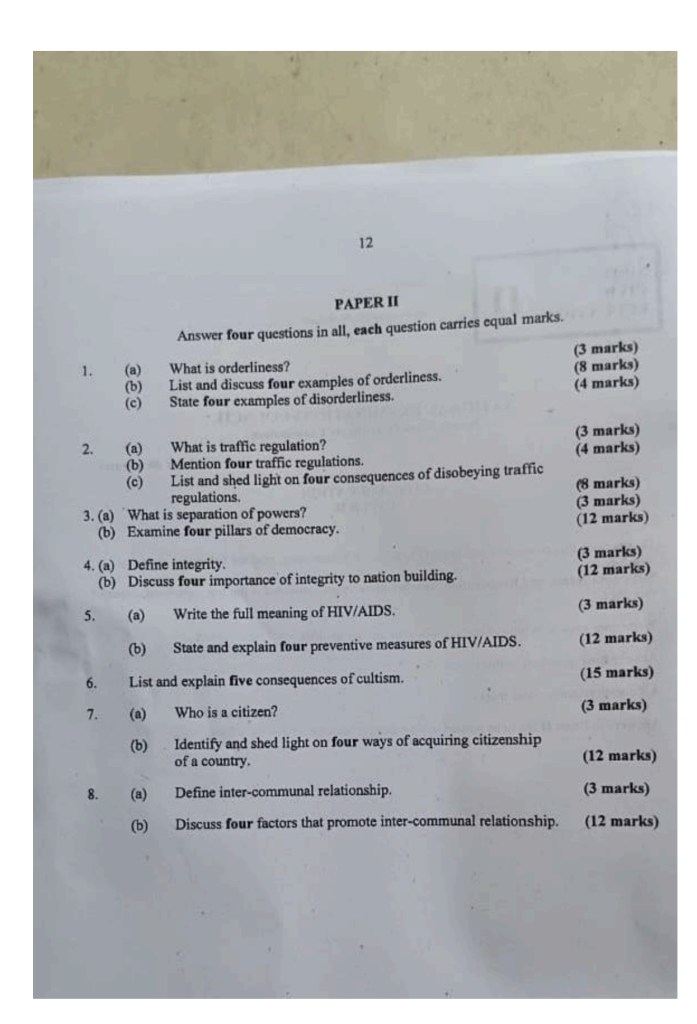
Number 1
(1a)
Orderliness is the act of behaving properly and arranging people, things or activities in a peaceful, organised and acceptable manner according to rules.
(1b)
(PICK ANY FOUR)
(i) Queuing: People should form an orderly line and wait for their turn at banks, bus stops, hospitals and other public places. This prevents confusion and fighting.
(ii) Obedience to traffic rules: Drivers and pedestrians should obey traffic lights, road signs and traffic officers. This helps to prevent accidents and traffic congestion.
(iii) Proper arrangement of property: Books, tools, files and other items should be kept in their correct places. This makes them easy to locate and prevents damage.
(iv) Respect for constituted authority: Citizens should obey lawful instructions given by parents, teachers, community leaders and government officials. This promotes peace and discipline.
(v) Punctuality: People should arrive at school, work, meetings and other engagements at the correct time. This prevents delay and improves productivity.
(vi) Taking turns during discussions: People should allow others to speak without interruption during meetings and conversations. This promotes mutual respect and understanding.
(vii) Proper waste disposal: Refuse should be placed in waste bins and approved disposal sites. This keeps the environment clean and prevents diseases.
(viii) Observance of rules and regulations: Members of schools, organisations and communities should follow established rules. This ensures smooth administration and peaceful coexistence.
(1c)
(PICK ANY FOUR)
(i) Jumping queues.
(ii) Disobeying traffic lights and road signs.
(iii) Littering the environment.
(iv) Fighting in public places.
(v) Interrupting others during discussions.
(vi) Coming late to school, work or meetings.
(vii) Vandalising public property.
(viii) Disobeying lawful authority.
Number 2
(2a)
Traffic regulation refers to the rules and laws made to control the movement of vehicles, cyclists and pedestrians on the road in order to ensure safety and orderliness.
(2b)
(PICK ANY FOUR)
(i) Obedience to traffic lights.
(ii) Observance of road signs.
(iii) Keeping to the correct lane.
(iv) Obedience to speed limits.
(v) Use of seat belts.
(vi) Avoidance of driving under the influence of alcohol or drugs.
(vii) Possession of a valid driving licence.
(viii) Giving way to pedestrians at zebra crossings.
(2c)
(PICK ANY FOUR)
(i) Road accidents: Disobeying traffic regulations may lead to collisions between vehicles or accidents involving pedestrians.
(ii) Loss of lives: Serious traffic accidents may result in the death of drivers, passengers and other road users.
(iii) Injuries and disability: Victims of road accidents may suffer fractures, burns or permanent physical disability.
(iv) Destruction of property: Vehicles, buildings, road facilities and other property may be damaged during accidents.
(v) Traffic congestion: Wrong parking, reckless driving and failure to obey traffic lights can obstruct movement and cause long traffic jams.
(vi) Arrest and punishment: Traffic offenders may be arrested, fined, prosecuted or have their driving licences withdrawn.
(vii) Financial loss: Offenders may spend money on medical treatment, vehicle repairs, fines and compensation to victims.
(viii) Emotional suffering: Families may experience grief, fear and trauma when their relatives are injured or killed in road accidents.
Number 3
(3a)
Separation of powers is the division of the powers and functions of government among the legislature, executive and judiciary.
It prevents one arm of government from controlling all governmental powers and allows each arm to perform its duties independently.
(3b)
(i) The legislature: This arm of government makes laws for the country, approves public expenditure and represents the interests of the people. It also checks the activities of the executive.
(ii) The executive: The executive implements laws and government policies. It manages the daily affairs of the country, maintains law and order and protects lives and property.
(iii) The judiciary: The judiciary interprets laws and settles disputes between individuals, organisations and government. It also protects citizens’ rights and ensures that government actions agree with the constitution.
(iv) The mass media: The media informs and educates citizens about government activities and public issues. It exposes corruption, provides a platform for different opinions and holds public officers accountable.
Number 4
(4a)
Integrity is the quality of being honest, upright and morally responsible in one’s words, actions and decisions, even when no one is watching.
(4b)
(PICK ANY FOUR)
(i) Reduction of corruption: Integrity discourages bribery, fraud, embezzlement and misuse of public funds. This allows national resources to be used for development projects.
(ii) Promotion of good leadership: Leaders with integrity make fair decisions and use public resources in the interest of the people. This improves governance and national progress.
(iii) Building of public trust: When leaders and citizens are honest, people develop confidence in government institutions and one another. This promotes cooperation in society.
(iv) Proper use of national resources: People with integrity protect public property and ensure that money meant for roads, schools, hospitals and other projects is not diverted.
(v) Promotion of justice and fairness: Integrity encourages equal treatment of citizens without favouritism, tribalism, discrimination or political influence.
(vi) Attraction of investment: A country known for honesty, accountability and respect for agreements attracts local and foreign investors. This creates employment and increases economic growth.
(vii) Promotion of peace and unity: Integrity reduces lies, betrayal and dishonest practices that may cause conflict. It therefore encourages peaceful coexistence among citizens.
(viii) Increase in productivity: Honest and responsible workers perform their duties diligently. This improves the quality of services and contributes to national development.
Number 5
(5a)
HIV means Human Immunodeficiency Virus.
AIDS means Acquired Immune Deficiency Syndrome.
(5b)
(PICK ANY FOUR)
(i) Abstinence from sexual intercourse: Unmarried people should avoid sexual intercourse because abstinence prevents exposure to HIV through sexual contact.
(ii) Faithfulness to one uninfected partner: Married partners should remain faithful to each other and avoid multiple sexual partners. This reduces the risk of contracting HIV.
(iii) Correct use of condoms: Sexually active persons should use condoms correctly and consistently. Condoms reduce contact with infected body fluids during sexual intercourse.
(iv) Screening of blood before transfusion: All donated blood should be properly tested for HIV before it is given to a patient. This prevents transmission through infected blood.
(v) Avoidance of shared sharp objects: People should not share needles, syringes, razor blades, clippers and other sharp objects because they may carry infected blood.
(vi) Use of sterilised medical instruments: Hospitals, clinics and laboratories should sterilise instruments properly or use disposable ones to prevent the transfer of infected blood.
(vii) HIV testing and counselling: People should undergo HIV testing to know their status. Early detection helps infected persons receive treatment and avoid transmitting the virus to others.
(viii) Prevention of mother-to-child transmission: Pregnant women should be tested for HIV and receive proper medical care and treatment. This reduces transmission to the baby during pregnancy, delivery or breastfeeding.
Number 6
(PICK ANY FIVE)
(i) Loss of lives: Cult clashes and revenge attacks may lead to the killing of cult members, students and innocent people.
(ii) Destruction of property: Cultists may destroy school buildings, vehicles, houses and business premises during violent attacks.
(iii) Disruption of academic activities: Cult violence may cause the suspension of lectures, closure of schools and cancellation of examinations.
(iv) Poor academic performance: Members may spend more time attending secret meetings and carrying out violent activities than studying, leading to failure in examinations.
(v) Expulsion from school: Students found guilty of cultism may be suspended or expelled from their institutions.
(vi) Arrest and imprisonment: Cult members may be arrested, prosecuted and imprisoned for offences such as murder, assault and possession of weapons.
(vii) Fear and insecurity: Cult activities create fear among students, teachers and members of the community and make the environment unsafe.
(viii) Increase in criminal activities: Cult groups may engage in robbery, kidnapping, rape, drug abuse and other crimes.
(ix) Injury and permanent disability: Victims of cult clashes may suffer serious injuries from guns, knives and other dangerous weapons, resulting in permanent disability.
(x) Damage to reputation: A person identified as a cultist may lose the trust and respect of family members, teachers, employers and society.
Number 7
(7a)
A citizen is a person who is legally recognised as a member of a country and is entitled to its rights and protection while performing the duties expected by the state.
(7b)
(PICK ANY FOUR)
(i) Citizenship by birth: A person may become a citizen by being born within the territory of a country, depending on the provisions of that country’s constitution.
(ii) Citizenship by descent: A person may acquire citizenship if either or both parents are citizens of the country, even when the person is born outside the country.
(iii) Citizenship by registration: A foreigner may become a citizen after applying and being officially registered. This may apply to a person married to a citizen or one with close connections to the country.
(iv) Citizenship by naturalisation: A foreigner who has lived in a country for a required number of years may apply for citizenship. The person must usually show good character, loyalty and willingness to obey the country’s laws.
(v) Citizenship by marriage: A person may acquire citizenship by marrying a citizen of another country, after meeting the legal requirements of that country.
(vi) Citizenship by adoption: A child adopted by citizens of a country may be granted the citizenship of the adoptive parents according to the law.
(vii) Honorary citizenship: A country may grant citizenship to a distinguished foreigner as an honour for exceptional service or contribution to the nation.
Number 8
(8a)
Inter-communal relationship is the peaceful interaction, cooperation and understanding that exist between people of different communities for their mutual benefit and development.
(8b)
(PICK ANY FOUR)
(i) Intermarriage: Marriage between people from different communities creates family ties and strengthens friendship. It reduces hatred and promotes peaceful coexistence.
(ii) Trade and commercial activities: Buying and selling between communities encourage regular interaction and economic cooperation. Communities are more likely to maintain peace when they benefit from one another.
(iii) Cultural festivals and social activities: Joint festivals, sports competitions and other social events bring people together. They help communities to understand and appreciate one another’s customs.
(iv) Effective communication: Regular communication between community leaders and members helps to prevent misunderstanding and false information. It also makes dispute settlement easier.
(v) Peaceful settlement of disputes: Conflicts should be resolved through dialogue, negotiation, mediation and arbitration instead of violence. This restores trust and promotes lasting peace.
(vi) Religious tolerance: People should respect the religious beliefs and practices of other communities. This reduces religious conflict and encourages unity.
(vii) Joint development projects: Communities may cooperate in building roads, markets, schools, hospitals and water facilities. Shared projects strengthen their relationship.
(viii) Good leadership: Responsible community leaders encourage tolerance, fairness and cooperation. They also prevent inflammatory statements and settle disagreements promptly.
COMPLETED!!!
TYPE G
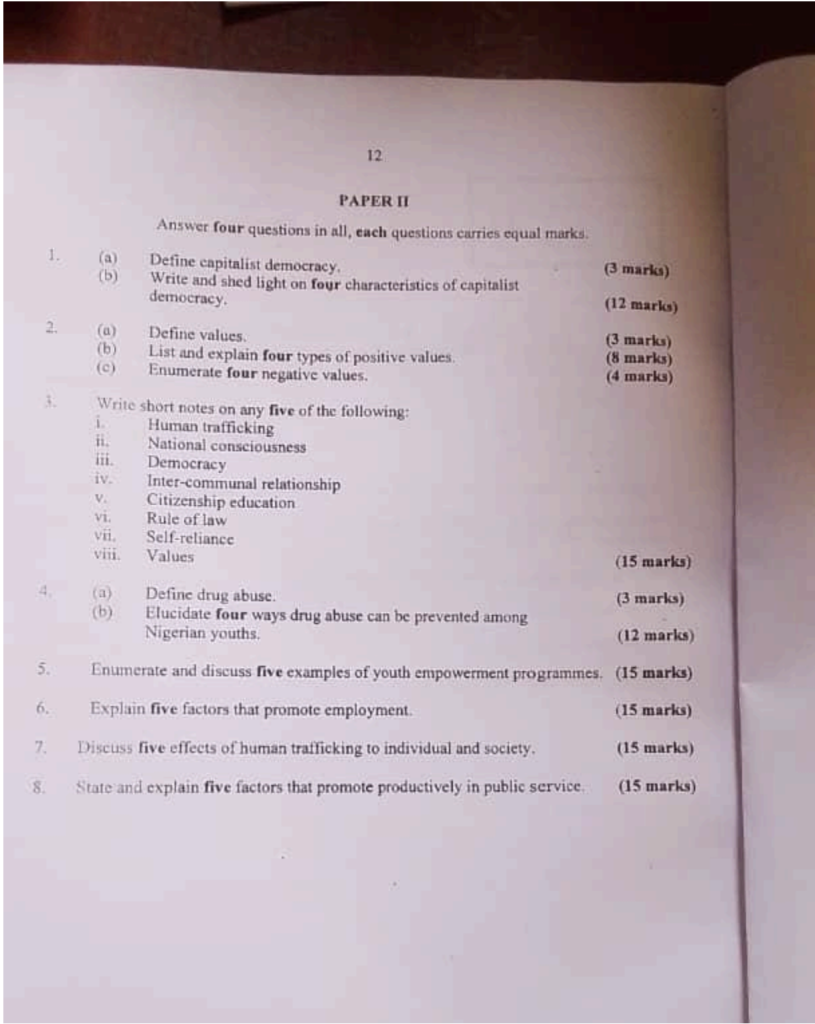
Number 1
(1a)
Capitalist democracy is a system of government in which political leaders are chosen through free and periodic elections, while individuals and private organisations are allowed to own property and operate businesses for profit.
(1b)
(PICK ANY FOUR)
(i) Free and periodic elections: Citizens are allowed to choose their leaders through regular elections. The elections should be conducted without intimidation, manipulation or violence.
(ii) Private ownership of property: Individuals and private organisations are free to own land, businesses and other means of production. Government ownership is limited.
(iii) Multi-party system: Different political parties are allowed to exist and compete for political power. This gives voters a choice among candidates and programmes.
(iv) Rule of law: Everyone, including leaders and government officials, must obey the law. No person should be punished except according to the law.
(v) Profit motive: Individuals establish businesses mainly to make profit. The desire for profit encourages investment, production and economic growth.
(vi) Freedom of enterprise: Citizens are free to choose their occupations, establish businesses and engage in lawful economic activities with limited government interference.
(vii) Protection of fundamental human rights: Citizens enjoy rights such as freedom of speech, movement, association, religion and peaceful assembly.
(viii) Competition: Political parties compete for votes, while private businesses compete for customers. Competition encourages better performance and improved services.
Number 2
(2a)
Values are the accepted beliefs, principles and standards that guide the behaviour, decisions and actions of individuals in society.
They help people to distinguish between what is right and what is wrong.
(2b)
(PICK ANY FOUR)
(i) Honesty: This is the quality of being truthful and sincere in words and actions. An honest person does not lie, cheat or steal.
(ii) Contentment: This is the ability to be satisfied with what one has while working honestly for improvement. It prevents greed, corruption and unnecessary competition.
(iii) Discipline: Discipline is the ability to obey rules and control one’s behaviour. It encourages punctuality, hard work and responsible conduct.
(iv) Integrity: This is the quality of being morally upright and doing what is right even when no one is watching.
(v) Respect: Respect involves recognising the rights, opinions and dignity of other people. It promotes peaceful coexistence in society.
(vi) Courage: Courage is the ability to face danger, difficulty or opposition without fear. It helps people to defend the truth and resist wrongdoing.
(vii) Tolerance: Tolerance is the willingness to accept and respect people whose beliefs, culture or opinions differ from one’s own.
(viii) Hard work: Hard work is the willingness to carry out duties diligently and persistently. It promotes achievement and national development.
(2c)
(PICK ANY FOUR)
(i) Dishonesty.
(ii) Greed.
(iii) Corruption.
(iv) Laziness.
(v) Disobedience.
(vi) Intolerance.
(vii) Selfishness.
(viii) Indiscipline.
Number 3
(PICK ANY FIVE)
(i) Human trafficking: Human trafficking is the illegal recruitment, transportation or harbouring of people through force, deception or coercion for the purpose of exploitation. Victims may be used for forced labour, prostitution, begging, slavery or other harmful activities.
(ii) National consciousness: National consciousness is the awareness, loyalty and sense of responsibility citizens have towards their country. It encourages people to place national interest above ethnic, religious and personal interests.
(iii) Democracy: Democracy is a system of government in which citizens choose their leaders through free and periodic elections. It promotes popular participation, accountability, rule of law and respect for human rights.
(iv) Inter-communal relationship: Inter-communal relationship is the peaceful interaction and cooperation between people of different communities. It promotes trade, cultural exchange, mutual understanding and peaceful coexistence.
(v) Citizenship education: Citizenship education is the process of teaching people about their rights, duties, responsibilities and accepted values. It prepares citizens to participate actively and responsibly in society.
(vi) Rule of law: Rule of law is the principle that everyone, including government officials, must obey the law. It also requires equality before the law and the protection of citizens’ rights.
(vii) Self-reliance: Self-reliance is the ability of a person to depend on personal knowledge, skills and resources to meet needs. It encourages hard work, creativity, independence and entrepreneurship.
(viii) Values: Values are accepted beliefs, principles and standards that guide the behaviour and decisions of individuals. Examples include honesty, discipline, contentment, tolerance and responsibility.
Number 4
(4a)
Drug abuse is the improper, excessive or illegal use of drugs without medical prescription or for purposes other than those for which they are intended.
It also includes taking prescribed drugs in the wrong quantity or manner.
(4b)
(PICK ANY FOUR)
(i) Public enlightenment: Government agencies, schools, religious bodies and the media should educate young people about the dangers and consequences of drug abuse.
(ii) Parental guidance and supervision: Parents should monitor their children’s activities, friends and behaviour. They should also provide proper counselling and moral instruction.
(iii) Strict enforcement of drug laws: Law enforcement agencies should arrest and prosecute people who produce, sell or distribute illegal drugs. This will reduce the availability of harmful substances.
(iv) Restriction on the sale of drugs: Pharmacies and medicine sellers should not sell controlled drugs without a valid medical prescription. Their activities should be regularly monitored.
(v) Provision of school counselling services: Schools should employ trained counsellors to advise students, identify those at risk and assist youths who are already abusing drugs.
(vi) Good peer influence: Young people should be encouraged to choose responsible friends and avoid groups that promote smoking, drinking or the use of illegal drugs.
(vii) Provision of employment and skills training: Government and private organisations should create jobs and empowerment programmes for youths. Productive engagement reduces idleness and frustration.
(viii) Establishment of rehabilitation centres: Treatment and rehabilitation facilities should be provided for youths who are already addicted. This helps them recover and return to normal life.
(ix) Promotion of recreational activities: Sports, clubs, debates and other useful activities should be encouraged to keep young people positively occupied.
(x) Control of drug advertisements: Advertisements that encourage the use of alcohol, tobacco and other harmful substances should be properly regulated, especially those directed at young people.
Number 5
(PICK ANY FIVE)
(i) Vocational skills-acquisition programme: This programme trains young people in practical trades such as tailoring, carpentry, welding, catering, hairdressing and plumbing. The skills acquired enable them to become self-employed and earn a living.
(ii) Entrepreneurship training programme: Youths are taught how to identify business opportunities, prepare business plans, manage money and operate small-scale enterprises. This helps them establish businesses and employ others.
(iii) Agricultural empowerment programme: Young people are trained in crop farming, livestock production, fishing and agricultural processing. They may also receive seedlings, fertilisers, farm tools and access to land.
(iv) Information and Communication Technology programme: This programme equips youths with skills in computer operation, coding, graphic design, website development and digital marketing. Such skills improve their employment and online business opportunities.
(v) Youth loan and grant programme: Government agencies, banks and private organisations provide loans or grants to young entrepreneurs. The money enables them to start or expand businesses and purchase necessary equipment.
(vi) Apprenticeship programme: Young people are attached to experienced artisans and business owners to learn a trade through practical experience. After training, they may receive tools or financial support to establish their own businesses.
(vii) Employment and job-placement programme: This programme connects qualified young people with available jobs in public institutions and private companies. It may also provide internships that help them gain work experience.
(viii) Sports development programme: Youths are trained in football, athletics, boxing and other sports. Talented participants may become professional athletes, coaches or sports officials.
(ix) Leadership development programme: Young people are trained in leadership, communication, decision-making and community service. This prepares them to become responsible leaders and active citizens.
(x) Cooperative society programme: Youths with similar economic interests form cooperative societies to save money, obtain loans and carry out joint business activities. This makes it easier for them to acquire equipment and market their products.
Number 6
(PICK ANY FIVE)
(i) Industrial development: Establishment and expansion of industries create employment for engineers, technicians, factory workers, drivers, accountants and other categories of workers.
(ii) Agricultural development: Government support for farming through loans, fertilisers, improved seedlings, irrigation and modern equipment creates jobs in crop production, livestock farming, fishing and agricultural processing.
(iii) Skills-acquisition programmes: Training people in tailoring, welding, carpentry, plumbing, catering, computer operation and other trades enables them to become self-employed and employ others.
(iv) Provision of credit facilities: Affordable loans and grants help individuals and businesses to establish or expand enterprises. Business expansion leads to the employment of more workers.
(v) Stable electricity supply: Reliable power reduces the cost of production and encourages industries and small businesses to operate successfully. This promotes expansion and job creation.
(vi) Good transportation facilities: Good roads, railways, airports and seaports make it easier to move people, raw materials and finished goods. This encourages investment and employment.
(vii) Favourable government policies: Tax reduction, investment incentives and support for local production encourage entrepreneurs and companies to establish businesses and employ workers.
(viii) Political stability and security: A peaceful and secure environment attracts local and foreign investors. New investments lead to the establishment of industries and creation of jobs.
(ix) Improvement in education: Quality education equips people with the knowledge, qualifications and practical skills required for available employment opportunities.
(x) Promotion of entrepreneurship: Teaching people how to identify business opportunities, prepare business plans and manage enterprises encourages self-employment and reduces dependence on government jobs.
Number 7
(PICK ANY FIVE)
(i) Physical injury and poor health: Victims may be beaten, sexually abused, overworked and denied proper medical care. This can lead to serious injuries, infections and permanent health problems.
(ii) Psychological trauma: Human trafficking may cause fear, depression, anxiety, shame and loss of self-confidence because of the threats and abuse experienced by victims.
(iii) Loss of freedom and dignity: Victims are often controlled by traffickers and forced to work, beg or engage in prostitution against their will. This violates their fundamental human rights.
(iv) Death and permanent disability: Some victims die during dangerous journeys or as a result of torture, disease and excessive labour. Others may suffer injuries that leave them permanently disabled.
(v) Loss of education and opportunities: Children and young people who are trafficked may be withdrawn from school. This prevents them from acquiring knowledge and reduces their future employment opportunities.
(vi) Breakdown of families: Families may be separated when their members are trafficked. Victims who return home may also find it difficult to rebuild relationships because of trauma and shame.
(vii) Increase in crime: Human trafficking encourages kidnapping, forgery, sexual exploitation, forced labour and other criminal activities. This increases insecurity in society.
(viii) Spread of diseases: Sexual exploitation and unsafe living conditions may increase the spread of HIV/AIDS and other sexually transmitted infections.
(ix) Loss of productive labour: Trafficking removes young and able-bodied people from education and legitimate employment. This reduces the productive workforce available for national development.
(x) Damage to the country’s reputation: A country known for widespread human trafficking may lose international respect and discourage tourists, investors and development partners.
Number 8
(PICK ANY FIVE)
(i) Adequate remuneration: Public servants should receive fair salaries, allowances and other benefits regularly. Good pay improves workers’ morale and reduces the temptation to engage in corruption.
(ii) Regular training and retraining: Workers should attend seminars, workshops and professional courses to improve their knowledge and skills. This enables them to perform their duties more effectively.
(iii) Provision of modern equipment: Public offices should be supplied with computers, vehicles, communication facilities and other necessary tools. Modern equipment makes work faster, easier and more accurate.
(iv) Promotion based on merit: Hardworking and qualified officers should be promoted according to competence, experience and performance. This motivates workers to remain committed to their duties.
(v) Good working conditions: Public servants should be provided with safe offices, suitable furniture, reasonable working hours and necessary welfare facilities. A comfortable environment increases efficiency.
(vi) Effective supervision: Senior officers should regularly monitor the activities of workers and ensure that assigned duties are properly performed. Weaknesses should be identified and corrected promptly.
(vii) Motivation and recognition: Outstanding workers should be rewarded through bonuses, awards, commendations and promotions. Recognition encourages them and other workers to improve their performance.
(viii) Adequate funding: Government ministries, departments and agencies should receive enough funds to carry out their programmes, maintain equipment and provide efficient services.
(ix) Enforcement of discipline: Rules concerning punctuality, attendance, honesty and proper conduct should be strictly enforced. Lazy, absent and corrupt officers should receive appropriate punishment.
(x) Proper division of labour: Duties should be assigned according to the qualification, training and ability of each worker. This reduces confusion, duplication of duties and waste of time.
TYPE H
Number 1
Answers Loading….
Number 2
Answers Loading….
Number 3
Answers Loading….
Number 4
Answers Loading….
Number 5
Answers Loading….
Number 6
Answers Loading….
Number 7
Answers Loading….
Number 8
Answers Loading….
Thank you good job