

Number 1
(1ai)
A – Pelvic Girdle of Rabbit/Small Mammal
B – Cervical Vertebrae of Rabbit/Small Mammal
C – Caudal Vertebrae of Rabbit/Small Mammal
D – Transverse Section of Paw-Paw Fruit
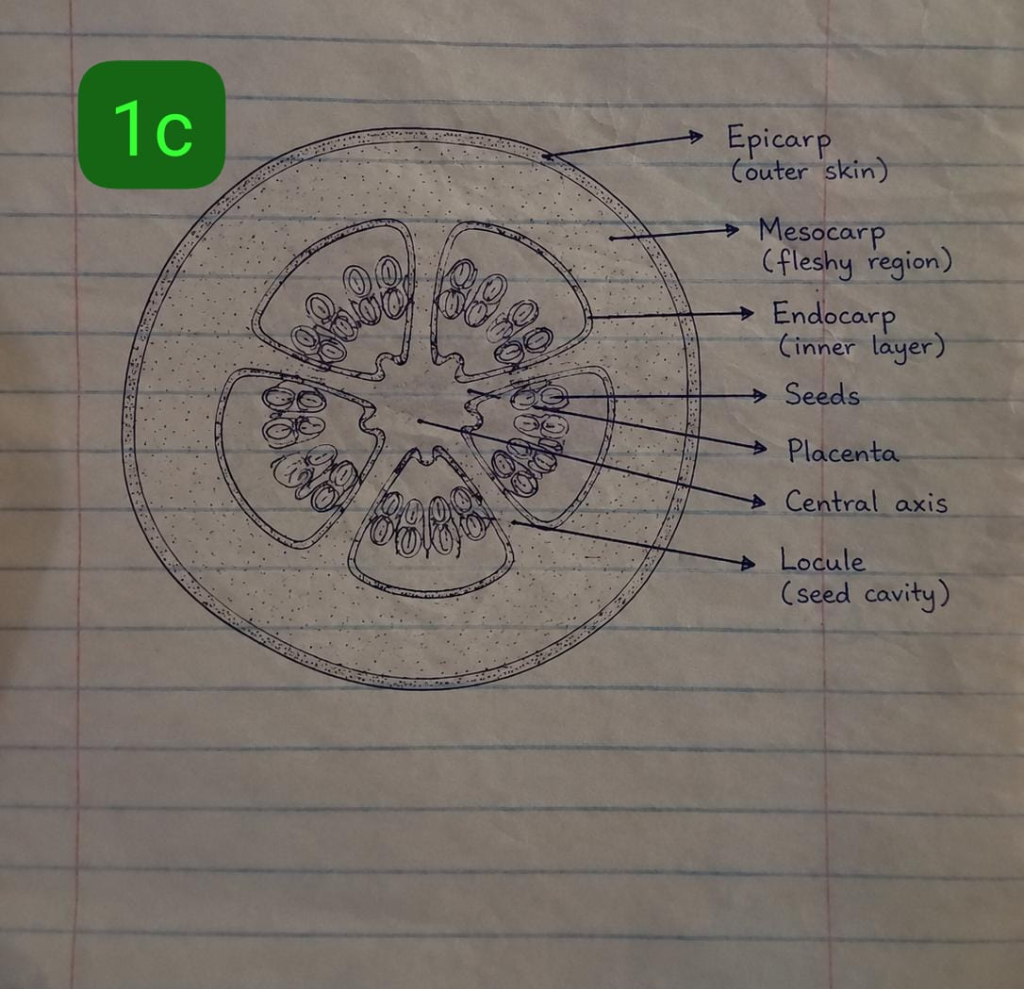
E – Transverse Section of Guava Fruit
(1aii)
A – Hip/Pelvic region (posterior region of the trunk)
B – Neck region (between the skull and thoracic vertebrae)
C – Tail region (posterior to the sacral vertebrae)
(1aiii)
(i)Ilium
(ii)Ischium
(iii)Pubis
(1aiv)
Fill The Table;
Under; B (Cervical Vertebrae)
(i)Has a large, broad neural canal/spine
(ii)Has transverse processes with foramina (holes for blood vessels)
Under; C (Caudal Vertebrae)
(i)Has a small or absent neural canal
(ii)Transverse processes are absent or rudimentary
(1av)
(i)Supports and allows movement of the head (nodding and rotation)
(ii)Protects the spinal cord passing through the neural canal
(1bi)
D (Paw-Paw) – Parietal placentation
E (Guava) – Axile placentation
(1bii)
D – The ovules/seeds are attached to the wall of the ovary
E – The ovules/seeds are attached to the central axis where the septa meet
(1c)
Number 2
(2ai)
F – Quill Feather
G – Agama Lizard
H – Rat/Rabbit
I – Quadrat
J – Sweeping Net
(2aii)
(i)Used for flight/enables the bird to fly
(ii)Provides insulation/helps to regulate body temperature
(iii)Provides streamlined body shape to reduce air resistance during flight
(2aiii)
(i)Scaly skin to reduce water loss in dry/terrestrial environment
(ii)Clawed toes for gripping and climbing on rocks and trees
(iii)Camouflage coloration to blend with surroundings for protection from predators
(2aiv)
G; (Agama Lizard) – Class Reptilia
H; (Rat/Rabbit) – Class Mammalia
(2av)
Fill The Table;
Under; G (Agama Lizard)
(i)Body covered with dry scales
(ii)Ectothermic (cold-blooded) – no diaphragm
H (Rat/Rabbit)
(i)Body covered with hair/fur
(ii)Endothermic (warm-blooded) – has a diaphragm
(2avi)
(i)Both have four limbs (tetrapods)
(ii)Both have a tail
(iii)Both have eyes and ears (sensory organs) used for detecting the environment
(2bi)
I; (Quadrat) – Used to estimate the population/abundance of organisms in a given habitat.
J; (Sweeping Net) – Used to collect/sample small flying or crawling insects from vegetation
(2bii)
(i)The quadrat is thrown/placed randomly on the ground in the study area.
(ii)All organisms (plants or animals) within the quadrat are identified and counted.
(iii)The count is repeated in several quadrats and an average is calculated to estimate population size per unit area
Number 3
(3a)
K – Housefly
L – Pride of Barbados Fruit/Pod
M – Cashew Nut
N – Millipede
O – Crab
P – Sorghum Grain
(3aii)
(i)Has sponging/lapping mouthparts (proboscis) for sucking liquid food
(ii)Has sticky foot pads to enable it land on any surface including food
(iii)Produces saliva containing digestive enzymes to liquefy solid food before ingestion
(3aiii)
It is a vector/carrier of diseases such as typhoid, cholera and dysentery, causing economic burden through healthcare costs.
(3bi)
K; (Housefly) – Class Insecta
N; (Millipede) – Class Diplopoda
O; (Crab) – Class Crustacea.
(3bii)
K; (Housefly) – Terrestrial/human settlements/refuse dumps
N; (Millipede) – Terrestrial/damp soil, under decaying leaves/logs
O; (Crab) – Aquatic/semi-aquatic (freshwater, marine or mangrove swamps)
(3ci)
L; (Pride of Barbados) – Legume/Pod (dry dehiscent fruit)
M: (Cashew Nut) – Nut (dry indehiscent fruit)
P: (Sorghum Grain) – Caryopsis/Grain (dry indehiscent fruit)
(3cii)
Fill The Table;
Under; N (Millipede)
(i)Has many legs (two pairs per segment)
(ii)Body is long and cylindrical/worm-like
Under; O (Crab)
(i)Has ten legs (five pairs)
(ii)Body is broad, flat and oval/rounded with a hard carapace