

NECO Biology OBJ
01-10: AECBAACADE
11-20: ECBDEBCDEA
21-30: CADBCDEBBD
31-40: DACEDDACBB
41-50: DBABEBEDAE
51-60: AAAEBDCBBB
COMPLETED!!!
NECO Biology Essay
Number 1
(1ai)
Tolerance is the ability of an organism to survive, grow and reproduce within a range of environmental conditions such as temperature, pH, salinity, light intensity, etc. Outside this range, the organism cannot survive.
(1aii)
(i)Oxygen – from lungs to body tissues
(ii)Carbon dioxide – from tissues to lungs for removal
(iii)Nutrients – e.g. glucose, amino acids from small intestine to cells
(iv)Waste products – e.g. urea to kidneys for excretion
Other acceptable: Hormones, Heat, Antibodies, Water
(1b)
(i)Prophase – Chromosomes condense, spindle fibres form, nuclear membrane breaks down
(ii)Metaphase – Chromosomes align at the equator/equatorial plate
(iii)Anaphase – Sister chromatids separate and move to opposite poles
(iv)Telophase – Nuclear membranes re-form, chromosomes uncoil, cytokinesis follows
(1c)
(i)Caste system/Social organization: Division of labour into workers, soldiers, queen and king for feeding, defense, reproduction and colony maintenance.
(ii)Mound building: They construct large ventilated termitaria/mounds that regulate temperature and humidity for the colony.
(iii)Fungus farming: Worker termites cultivate fungus gardens in the nest which serve as food, especially during dry seasons.
(iv)Trophallaxis: Sharing of digested food mouth-to-mouth among colony members, and transfer of cellulose-digesting protozoa.
(v)Swarming/Reproductive flight: Winged reproductives leave the nest at specific times to mate and start new colonies, avoiding overcrowding and inbreeding
Number 2
(2ai)
(i)Kidney – Mammals e.g. human
(ii)Nephridium – Annelids e.g. Earthworm
(iii)Malpighian tubule – Insects e.g. Cockroach
(iv)Contractile vacuole – Unicellular organisms e.g. Amoeba, Paramecium
(v)Flame cell – Platyhelminthes e.g. Planaria/Liver fluke
(2bi)
(i)Both are paired excretory organs that remove nitrogenous waste from the blood.
(ii)Both are made up of tubules and are involved in osmoregulation.
(2bii)
TABULATE
Under; Earthworm – Nephridium
(i)Simple tubular structure, one pair per segment
(ii)Opens to exterior by nephridiopore
(iii)Excretes mainly ammonia
Under; Mammals – Kidney
(i)Complex bean-shaped organ with millions of nephrons
(ii)Opens via ureter to urinary bladder
(iii)Excretes mainly urea
(2c)
Stomata open and close due to changes in turgor pressure of guard cells.
Opening: During the day, light stimulates accumulation of K+ ions and sugars in guard cells → water enters by osmosis → guard cells become turgid and bow outward, creating a pore.
Closing: At night or under water stress, K+ ions and water leave guard cells → they become flaccid and collapse inward, closing the pore. ABA hormone also promotes closure.
Number 3
(3ai)
-Protein:
(i)Carbon.
(ii)Hydrogen.
-Carbohydrate:
Carbon, Hydrogen, Oxygen
(3aii)
Diagram;
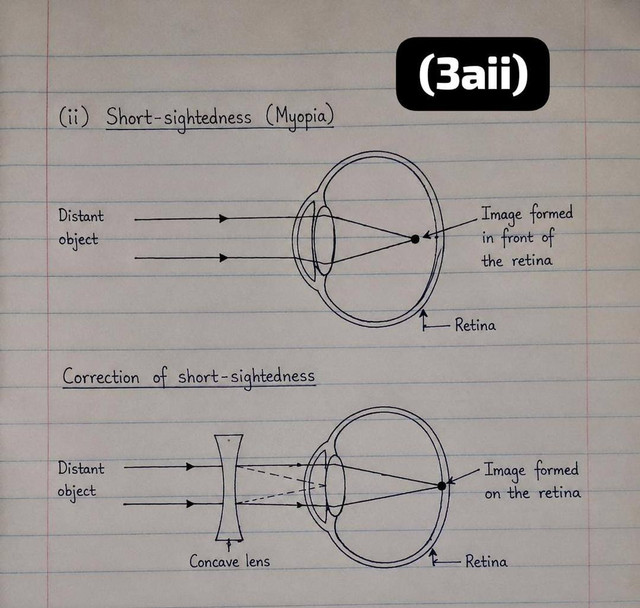
(3aiii)
(i)Birth rate/Natality
(ii)Death rate/Mortality
(3b)
(i)Swarming: A sudden large-scale movement of organisms, especially insects like bees, locusts or termites, often for reproduction, migration or food.
(ii)Epidemic: A sudden outbreak of a disease that spreads rapidly and affects a large number of people in a community or region at the same time.
(3ci)
Parthenocarpy: The development of fruit without fertilization, resulting in seedless fruits e.g. banana, pineapple.
(3cii)
(i)Barrier method – e.g. condom, diaphragm
(ii)Hormonal method – e.g. birth control pills, implants..
Number 4
(4ai)
(i)They are protein in nature, and they are highly specific in their action.
(ii)They are reusable and remain unchanged after a reaction.
(iii)They are temperature and pH sensitive.
(4aii)
(i)Pupil: Controls the amount of light entering the eye by dilating or constricting.
(ii)Conjunction (Conjunctiva): Protects the eye by providing lubrication and preventing microbes from entering.
(iii)Cornea: Acts as the outermost lens to refract (focus) light as it enters the eye.
(4bi)
TABULATE;
UNDER; Transpiration:
(i)Loss of excess water in form of water vapour from aerial parts of plants
(ii)Occurs mainly through stomata, lenticels and cuticle of plants
(iii)The water lost is not a metabolic waste product
UNDER; Excretion;
(i)Removal of metabolic waste products from the body of organisms
(ii)Occurs through specialized organs like kidney, skin, lungs, gills
(iii)Involves removal of toxic/used-up substances like urea, CO2, excess salts
(4bii)
(i)Shoulder joint; between head of humerus and glenoid cavity of scapula
(ii)Hip joint: between head of femur and acetabulum of pelvic girdle
(4c)
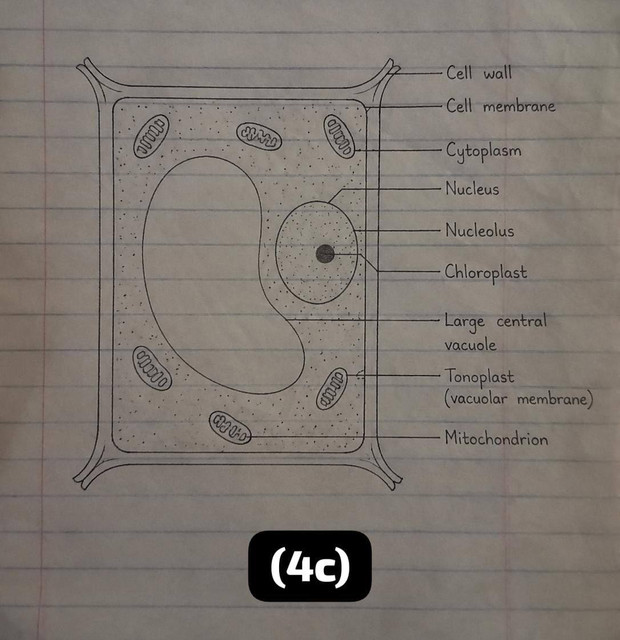
Number 5
(5a)
TABULATE;
UNDER; Root:
(i)Grows downwards into the soil/positively geotropic
(ii)Bears no leaves, flowers, buds or nodes
(iii)Has root hairs for absorption of water and mineral salts
UNDER; Stem:
(i)Grows upwards or horizontally/negatively geotropic, positively phototropic
(ii)Bears leaves, flowers, buds and nodes
(iii)Has no root hairs; has buds in the axils of leaves
(5aii)
(i)Large and strong body/centrum: To support body weight.
(ii)No facets for ribs: Unlike thoracic vertebrae.
(iiii)Short, broad, flat spinous process: Projects horizontally backward for muscle attachment.
(5bi)
(i)Collenchyma; living cells with unevenly thickened walls, provides flexible support
(ii)Sclerenchyma; dead cells with lignified thick walls, provides rigid support
(iii)Xylem: conducts water and mineral salts and gives mechanical support
(5bii)
(i)Haemophilia: An inherited sex-linked recessive disorder in which blood fails to clot normally due to deficiency of clotting factors.
(ii)Mutation: A sudden, random and heritable change in the DNA sequence or chromosome structure of an organism.
(iii)Sex-linked character: A trait whose gene is located on a sex chromosome, usually the X-chromosome e.g. colour blindness, haemophilia.
(5ci)
(i)Arable farming.
(ii)Pastoral farming.
(iii)Mixed farming
(5cii)
(i)Drying/Dehydration.
(ii)Refrigeration/Freezing