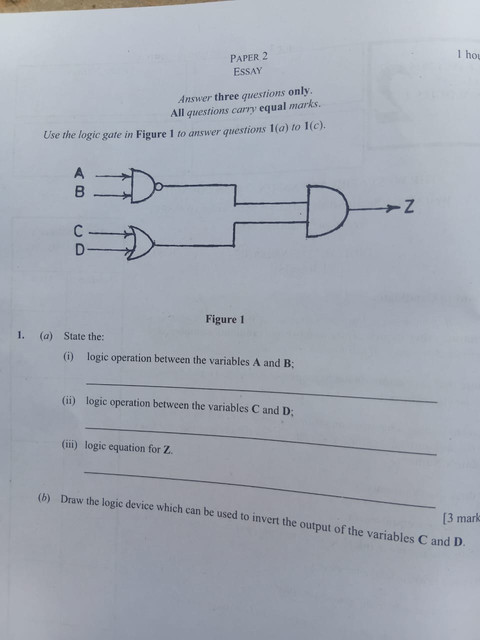
Candidates looking for WAEC Digital Technologies questions and answers for 2026 can use this page for fresh exam-day updates. Updates may come in parts, so keep checking back and refresh this page regularly.
Both the objective and essay sections for WAEC Digital Technologies 2026 will be updated here. The objective part may appear first, while the essay answers may be added gradually.
WAEC Digital Technologies OBJ Answers 2026
01-10: CBABADCDBA
11-20: CCDADABCDC
21-30: ADDBBDABAA
31-40: CBBBCBDDBA
41-50: CCDBBACADC
COMPLETED!!!
WAEC Digital Technologies Essay Answers 2026
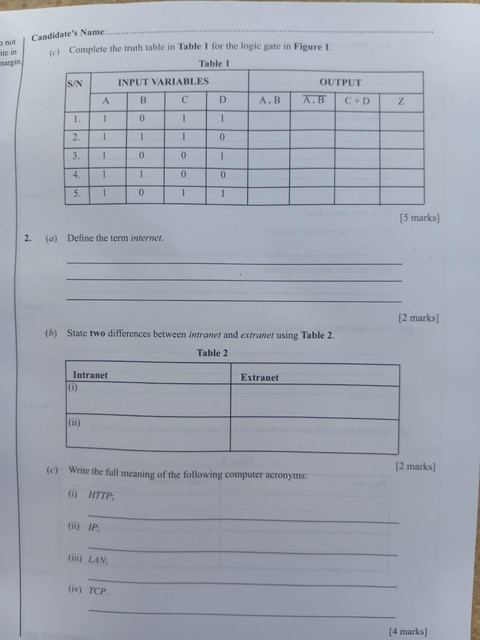
Number 2
(2a)
The Internet is a worldwide network of interconnected computers used for sharing information and communication.
(2b)
[TABULATE]
=INTRANET=
(i) Used within an organization only.
(ii) Access is restricted to employees.
=INTERNET=
(i) Used by authorized outsiders and members of an organization.
(ii) Access is given to external users such as customers or suppliers.
(2c)
(i) HTTP: HyperText Transfer Protocol
(ii) IP: Internet Protocol
(iii) LAN: Local Area Network
(iv) TCP: Transmission Control Protocol
(2d)
(i) TCP/IP (Transmission Control Protocol/Internet Protocol)
(ii) HTTP (HyperText Transfer Protocol)
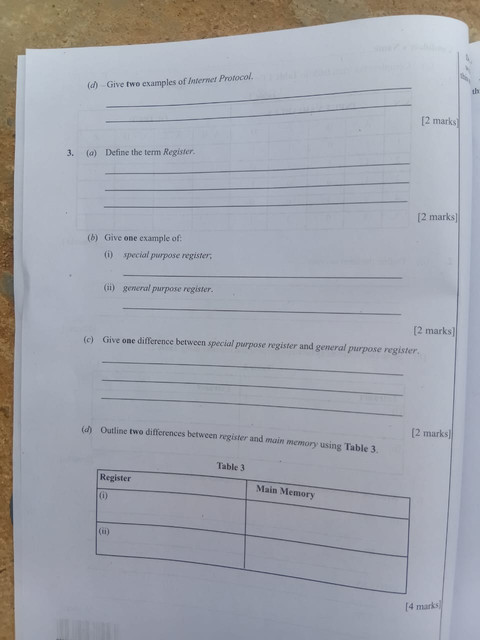
Number 3
(3a)
register is a small, high-speed storage location within the CPU used to quickly accept, store, and transfer data and instructions that are being used immediately.
(3b)
(i) Special purpose register: Program Counter (PC), Instruction Register (IR), or Memory Address Register (MAR).
(ii) General purpose register: Accumulator (ACC) or Data Register
(3c)
Special purpose registers are designed to perform a specific task (like holding the address of the next instruction), whereas general purpose registers can be used by programmers to store any data or intermediate results during processing.
(3d)
Tabulate
(i) SpeedExtremely fast; operates at CPU speed.Slower than registers.
(ii) CapacityVery small (typically bytes).Much larger (typically Gigabytes).
(iii) LocationLocated inside the CPU.Located outside the CPU on the motherboard.
Number 4
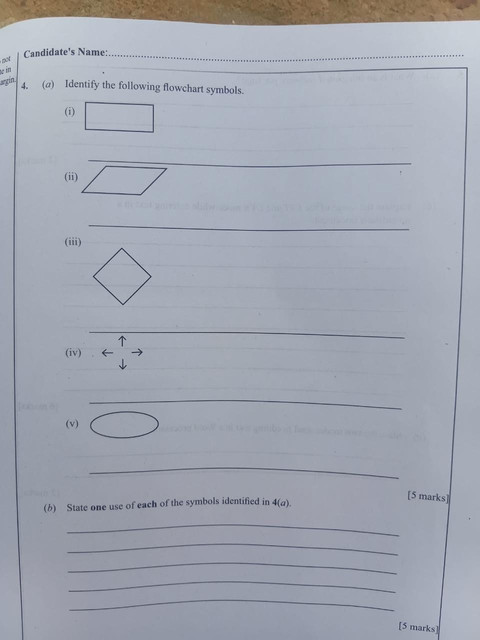
(4a)
(i) Rectangle: Process
(ii) Parallelogram: Input/Output
(iii) Diamond: Decision
(iv) Arrows: Flowlines (Direction of flow)
(v) Oval/Ovals: Terminator (Start/End)
(4b)
(i)Process (Rectangle): Used to represent a set of operations that change value, form, or location of data, such as a calculation (e.g., \(x = a + b\)).
(ii)Input/Output (Parallelogram): Represents the act of entering data into the system or displaying results to the user (e.g., “Read A” or “Print Total”).
(iii)Decision (Diamond): Used to show a conditional step where a question is asked (usually Yes/No or True/False), determining which path the flow will take.
(iv)Flowlines (Arrows): Used to connect the symbols and indicate the exact sequence and direction in which the steps are performed.
(v)Terminator (Oval): Marks the starting point and the ending point of the entire flowchart process.
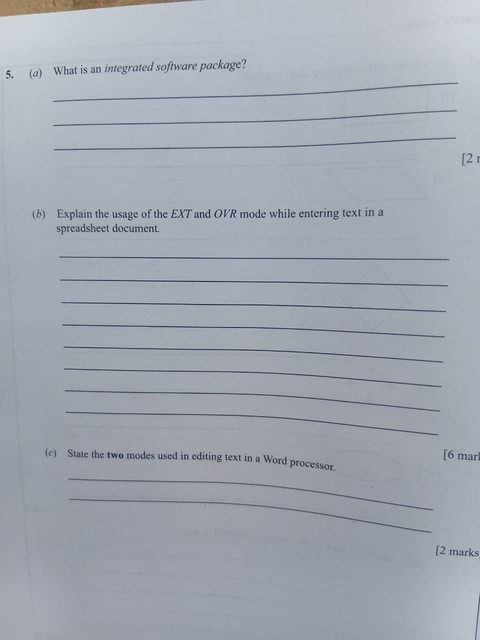
Number 5
(5a)
An integrated software package is a collection of related application programs bundled together as a single unit. These programs (such as a word processor, spreadsheet, and database) share a common user interface and allow for the easy transfer of data between them.
(5b)
(i)EXT (Extend Selection Mode): When this mode is active, you can use the arrow keys to extend the current selection of cells. Instead of moving the cursor to a new cell, the program “stretches” the highlighted area from the original cell to the new one.
(ii)OVR (Overtype Mode): In this mode, any new character you type replaces (overwrites) the existing character at the cursor position. This is the opposite of the standard Insert mode, where new text is pushed in between existing characters.
(5c)
(i)Insert Mode: The default mode where new text is inserted at the cursor, pushing existing text to the right.
(ii)Overtype (or Overwrite) Mode: A mode where new text replaces the existing text character-by-character as you type.