WAEC Bookkeeping OBJ 2025
01-10: BDCDBABACA
11-20: DADABABBAA
21-30: DBCCADBBDD
31-40: CBCAABCDCA
COMPLETED!!!
WAEC Bookkeeping Essay 2025
Number 1
(1a)
(i)The General Ledger, which serves as the central repository of all financial transactions recorded by the enterprise.
(ii)The Sales Ledger, dedicated to recording all sales transactions, tracking receivables.
(iii)The Purchase Ledger, which records all purchases made by the enterprise.
(iv)The Cash Book, which functions as both a journal and a ledger for recording all cash and bank transactions.
(1b)
(i)Enhanced Financial Accuracy: Mr. Adamu’s meticulous record-keeping ensures precision in financial reporting, minimizing errors and enhancing the reliability of financial data.
(ii)Improved Financial Planning: With accurate and up-to-date records, the enterprise can engage in more effective budgeting and financial forecasting, supporting strategic decision-making.
(iii)Regulatory Compliance: By maintaining comprehensive and accurate records, Mr. Adamu helps ensure that XYZ Enterprises adheres to all relevant financial regulations and reporting standards, reducing the risk of penalties and enhancing reputational credibility.
==================
Number 2
(2a)
(i)Expenditure Control
(ii)Simplified Accounting
(2b)
(i)Nature of Transactions: The cash column records transactions involving physical cash, such as cash sales or cash payments, while the bank column captures transactions involving bank accounts, such as cheques issued or deposits made.
(ii)Frequency of Transactions: Typically, cash transactions occur more frequently and in smaller amounts compared to bank transactions, which are often larger and fewer in number.
(iii)Reconciliation Process: The cash column is reconciled with the physical cash on hand, whereas the bank column must be reconciled with bank statements, necessitating a different reconciliation approach.
==================
Number 3
(3a)
A balance sheet is a fundamental financial statement that provides a snapshot of an enterprise’s financial position at a specific point in time.
(3b)
(i)Dual Aspect
(ii)Snapshot in Time
(iii)Classification
(3c)
(i) Bought goods by cheque: This transaction decreases the bank balance (asset) and increases inventory (asset), maintaining the balance.
(ii) Paid creditors by cheque: Reduces both the bank balance (asset) and accounts payable (liability), reflecting a decrease in both assets and liabilities.
(iii) Additional capital introduced by the owner: Increases the bank balance (asset) and owners’ equity, enhancing the financial position.
(iv) Bought motor vehicle on credit: Increases both non-current assets (motor vehicle) and liabilities (accounts payable), maintaining the balance.
(v) Owners withdrew money from the business: Decreases the bank balance (asset) and owners’ equity, reflecting a reduction in financial resources.
==================
Number 4
(4a)
Depreciation is a critical accounting concept reflecting the gradual reduction in the value of a tangible fixed asset over its useful life.
(4b)
(i)Physical Wear and Tear: Regular use leads to physical deterioration, diminishing the asset’s efficiency and value.
(ii)Obsolescence: Technological advancements can render an asset outdated, reducing its market value.
(iii)Legal or Contractual Limits: Certain assets have legal or contractual usage limits, leading to depreciation as these limits approach.
(iv)Time Passage: Simply the passage of time can depreciate certain assets, even with minimal active use.
(4c)
Scrap Value: The residual value of an asset at the end of its useful life, representing the expected recovery value upon disposal. WHILE Estimated Useful Life: The anticipated duration over which an asset is expected to be economically productive for the enterprise. Understanding these concepts and their implications is essential for effective financial management and strategic planning within any business enterprise.
==================
Number 5
Answers Loading…
==================
Number 6
SECTION B
(6)
Error (i): Cash received from Tayo debited to Taye
-Correction: Debit Tayo’s account and credit Taye’s account with N 7,900.
Error (ii): Goods worth N 7,500 posted to suppliers’ account as N 5,700
-Correction: Debit suppliers’ account with N 1,800 (N 7,500 – N 5,700).
Error (iii): Total discount allowed carried forward as N 5,600 instead of N 6,500
-Correction: Debit discount allowed account with N 900 (N 6,500 – N 5,600).
Error (iv): Proceeds from sale of old machine credited to sales account
-Correction: Debit sales account with N 46,700 and credit machinery disposal account (or a suitable account) with N 46,700.
Error (v): Discount allowed credited to discount received account
-Correction: Debit discount received account with N 6,200 and credit discount allowed account with N 6,200.
Error (vi): Bad debt recovered credited to customer’s personal account
-Correction: Debit customer’s account with N 6,500 and credit bad debt recovered account with N 6,500.
==================
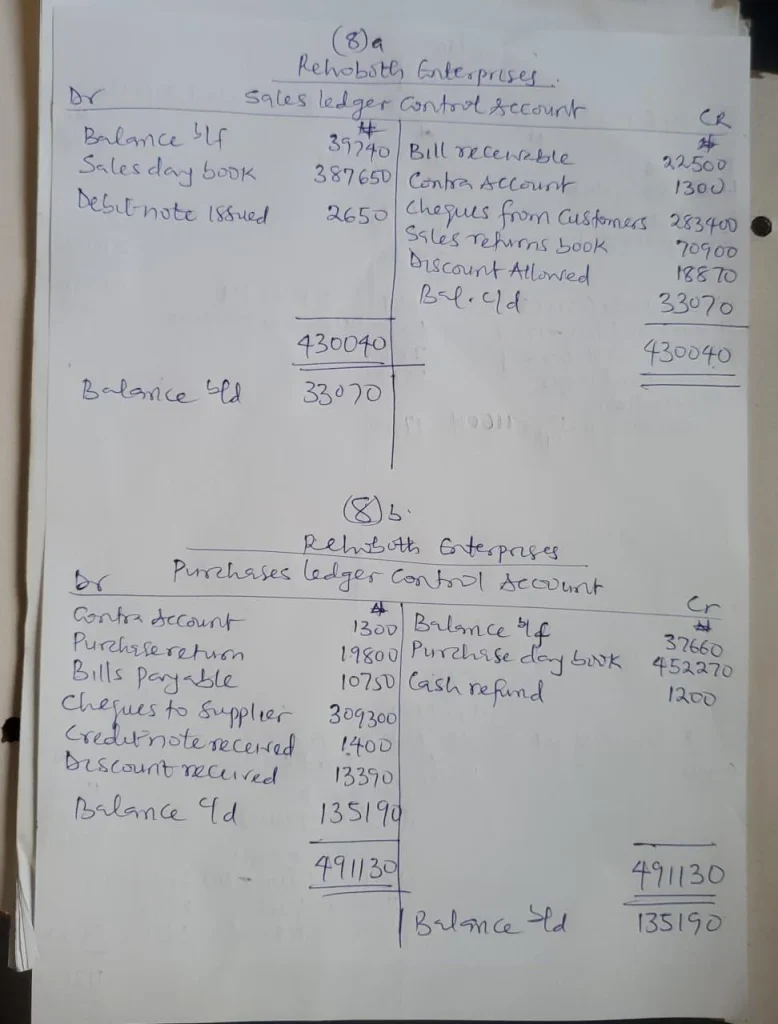
Number 8